


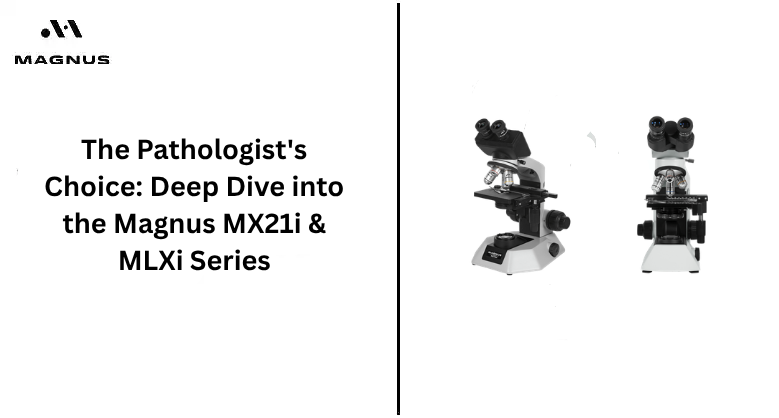
Microscopes serve as the primary basis in the medical industry. Every diagnosis needs a careful examination and analysis with extra care and attention. To make this process seamless, Magnus microscopes are evolving with new inventions.
The Magnus MX21i and MLXi series give advanced features of digitalisation to your microscopes. To know more about it and how it is valued in the stream of pathology, keep reading, as this blog covers all about Magnus MX21i and MLXi plus series.
Pathology and Microscopes
Pathology is the branch of medical science that studies diseases and focuses on their causes, development, and effects on the body. So, it involves heavy visual analysis. From identifying infectious organisms to evaluating cellular abnormalities, it needs the help of microscopes.
There are several kinds of microscopes used in many industries. In the medical industry, pathological microscopes are one of the most common and daily essential microscopes. It helps pathologists understand the patterns of cells, tissues, and microorganisms and find what is wrong with them.
There are two aspects that are very important for pathologists. That is, clarity and precision of microscope imaging are mandatory for accurate diagnosis. It helps a lot in decision-making processes.
Magnus MX21i Series
The Magnus MX21i microscopes are digital microscopes used for clinical purposes in diagnostic laboratories and educational uses. Known for its precision optics and ergonomic construction, it provides consistent high-quality imaging for a wide range of biological samples.
The microscope includes a set of Plan Achromat objectives:
- 4× objective for scanning
- 10× objective for low-power observation
- 40× objective for detailed cellular examination
- 100× oil immersion objective for microbial analysis
Specifications of Magnus MX21i Series
The MX21i microscopes are known for their specifications and unique features. Some of those are:
Digital Technology
MX21i is built with advanced digital technology. It has Cilika technology. It gives image clarity and colour accuracy. These make the images look sharper and more true-to-life visualisations of specimens.
Sounding Facility
It captures still images and videos with sound. This is one of its specialities, making it more apt for your pathological uses.
iPad Head
MX21i comes with an iPad head to make your observation a very easy process. The iPad has a 10.2-inch screen and comes with 64GB of storage. It also has an 8-megapixel camera. With this, you also get an iPad mounting adaptor. This means you don’t need an observation tube and eyepiece.
Ergonomic Design
Pathologists and lab technicians spend a lot of time analysing slides and specimens. Poor ergonomics can cause neck pain, eye fatigue, and reduced productivity. These problems are solved by MX21i with its ergonomic options. They are:
- 30° inclined binocular or trinocular viewing head
- 360° rotatable tube for flexible positioning
- Adjustable interpupillary distance (48–75 mm)
- Widefield 10× eyepieces with FN 20 mm
Illumination Base
If you want the images of your microscope to be clear, then you need proper lights. This is taken care of by the illumination base of the microscope. This is because uneven illumination can obscure cellular details and reduce diagnostic accuracy. The MX21i offers multiple illumination options:
- 6V 20W halogen lamp
- 3W high-brightness LED system
- LED illumination with battery backup
The LED illumination system provides uniform brightness, lower heat output, and a long lifespan of around 30,000 hours. This makes the microscope energy-efficient and reliable for long laboratory sessions.
Slide Navigation
The specimen focus needs to be proper if you want a clear view. So, you need a proper focusing system. The MX21i offers:
- Rackless mechanical stage (120 mm × 132 mm)
- Co-axial X-Y slide movement controls
- Traverse range of 76 mm × 30 mm
- 0.25mm control focus rotation
Magnus MLXi Series
The Magnus MLXi Plus series is the advanced version of pathological microscopes. They come with modern binocular and trinocular laboratory microscopes. They are built with additional optical capabilities and improved imaging flexibility. This series is the improved version of the MX21i series.
Specifications of Magnus MLXi Plus Series
The MLXi Plus microscopes are advanced with many specifications. Those include:
Infinity Corrected Optical System
The MLXi plus microscope uses infinity-corrected plan achromatic optics. This means it produces high-resolution images with good field flatness. These optics help in minimising distortion. Further, this ensures that specimens remain sharp even at high magnification levels.
Anti-fungal Treated Optics
The optical parts are treated with anti-fungal coatings. This protects the microscope lenses from fungal growth. This is particularly useful in humid laboratory environments.
Ergonomic Head
The ergonomic viewing head of the Magnus MLXi microscope series is designed to provide comfortable observation during prolonged laboratory use. These heads allow smooth rotation, easy eye adjustment, and stable mounting.
- 30° inclined Siedentopf head for a comfortable viewing posture
- 360° rotatable head for easy adjustment
- Diopter and eyepoint adjustment for individual eye focus correction
- Two working heights: minimum 370 mm and 430 mm for flexibility
- Interpupillary distance range: 48–75 mm
Inward Facing Nosepin
The inward-facing, quadruple-revolving nosepiece of the Magnus MLXi Plus microscope is designed to improve stability and ease of operation. The objectives are positioned inward, which helps maintain better alignment and balance of the optical system.
Dual Slide Holder
The dual slide holder in the Magnus MLXi Plus microscope allows two microscope slides to be placed on the stage at the same time. This improves efficiency by enabling quick comparison and continuous observation without frequently changing slides.
Why Do Pathologists Prefer the MX21i and MLXi Plus Series?
Several factors lead to the popularity of these Magnus microscopes among pathology professionals. They are:
- Consistent optical clarity for accurate diagnosis
- Comfortable ergonomic design for long hours of usage
- Durable construction for demanding laboratory environments
- Versatile imaging capabilities for different microscopy techniques
- Digital compatibility for documentation and collaboration
Together, these features create a microscope that balances performance, reliability, and ease of use.
Final Words
In pathology, where every microscopic detail influences a diagnosis, having a reliable microscope is necessary. Magnus MX21i and MLXi Plus Series microscopes show how advanced optics, ergonomic design, and flexible construction can improve laboratory efficiency. With a strong expertise in optical technology, Magnus Opto continues to empower pathologists and researchers with microscopes built for precision and long-term reliability.
FAQ’S
-
1. What is the Magnus MX21i microscope used for?
The Magnus MX21i microscope is used in clinical and pathology laboratories for detailed examination of cells, tissues, and microorganisms with high precision imaging. -
2. What is the difference between MX21i and MLXi Plus microscopes?
The MX21i is designed for standard clinical diagnostics, while the MLXi Plus offers advanced infinity-corrected optics, improved ergonomics, and higher imaging performance for research and complex analysis. -
3. Are Magnus microscopes suitable for pathology labs?
Yes, Magnus MX21i and MLXi Plus microscopes are designed specifically for pathology labs, offering accurate imaging, ergonomic design, and reliable diagnostic performance. -
4. What are the key features of the MLXi Plus microscope?
The MLXi Plus features infinity-corrected optics, anti-fungal lenses, dual slide holder, ergonomic viewing head, and high-resolution imaging for advanced laboratory use. -
5. Does the MX21i microscope support digital imaging?
Yes, the MX21i microscope supports digital imaging with integrated camera systems that allow image capture, video recording, and digital documentation of samples. -
6. Why is LED illumination important in laboratory microscopes?
LED illumination provides consistent brightness, reduces heat generation, and ensures long-lasting performance for accurate and comfortable specimen observation.