

How Compound Microscopes Help Students Understand Cells and Microorganisms
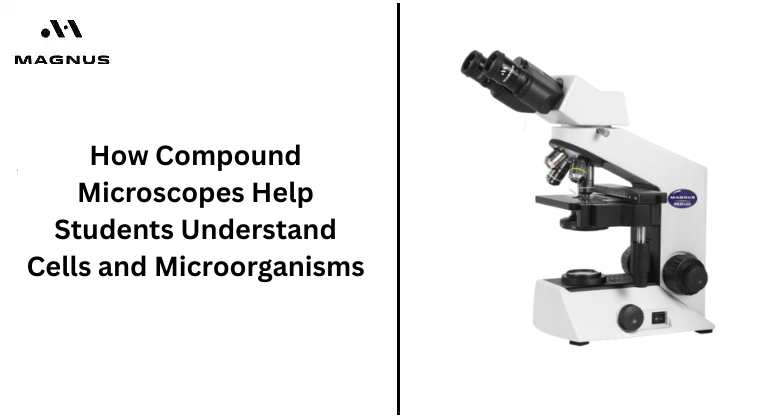
The comprehension of science becomes a lot simpler for students if they can observe the objects that they have been reading in their textbooks through practical works. Compound microscope is one such instrument that enables students to observe various things including cells, microorganisms, tissues, and other microscopic samples of biological nature.
This helps the students to make practical use of theoretical knowledge of biology inside the laboratory. The students will be able to observe some prepared slides, observe some living organisms, identify different components of the cells, and learn laboratory microscope skills.
How a Compound Microscope Works and Its Importance
The compound microscope working principle depends on use of two lens systems to increase the magnification of the object. The objective lens serves to magnify the object while the eyepiece increases the magnification of the image produced. An inbuilt source of light serves to light up the specimen.
The students can view live specimens placed on glass slides using the microscope. The component parts of the Compound microscope are the ocular lens, objective lenses, stage, condenser, diaphragm, light source, and focusing controls.
5 Ways Compound Microscopes Help Students Learn
Revealing Cell Structures
There are various cellular components which can be observed using specimen identification. Students can observe the structure and arrangement of individual cells using onion skin specimen which are simple specimens. Specimens of leaves of plants can be used for observation of chloroplasts.
The function of chloroplasts in the process of photosynthesis can be learned using this specimen. Another specimen which can be used is of animal cheek cells which can be used for the observation of cell membrane, nucleus and cytoplasm.
The above observations can help students relate diagrams in biology textbooks to the actual specimen. Observations relating to the shape and arrangement of the cells will make it easy for students to understand and memorize the lessons on cell structure.
Microorganisms Observation
With the aid of a microscope, students get to observe microorganisms in samples like pond water. Students will get a chance to view protists, algae, and other microorganisms through magnification.
The students will be able to compare various organisms and make notes on their observations during their practical sessions. It will acquaint students with the world of microscopic organisms and how diverse living things are.
It is a significant aspect of using a compound microscope in biology since the students get to work directly with living matter.
Connecting Theory to Practical Learning
The compound microscope in education helps transform theoretical lessons into practical experiences. Those learning about the theory of cells, microorganisms, tissue, or plant anatomy can study specimens on the corresponding subjects.
The teachers can teach the biological concept to students and subsequently demonstrate to them how they will be able to view specimens in relation to the concept they have learned. They can examine the structures, draw the same, record the observations and relate the findings with those seen in books.
This is sure to enhance practical knowledge and help students to focus on details. Regular observation in the laboratory will help students develop a sense of curiosity and ask questions.
Developing Laboratory Skills
The use of microscopes provides students with hands-on training at the science laboratory. In the course of this training, students learn how to mount slides, adjust light, select objectives and use coarse and fine focusing.
Slide preparation acquaints students with the technique of specimen preparation for viewing under the microscope. The students get to know how to deal with glass slides, cover slips, and various other laboratory apparatus.
This makes applied biology through application of scientific knowledge along with usage of various apparatus and observation techniques. Students also learn the ability of recording observations in an effective manner through diagrams and writing.
Understanding Different Specimens
Students can observe various biological specimens under the microscope. Various specimens, including plant cells, animal cells, blood cells, tissue cells, algae, and others, present various areas for learning.
The prepared specimens help students to make comparisons between plant and animal cells and recognize their differences and similarities. The teachers will have the opportunity to select different specimens according to the topic they are teaching.
The applications of compound microscope are varied since they can be used in many biology fields since the use of the same microscope can help in teaching about cell biology, microbiology, anatomy, and basic lab sciences.
Advantages of Compound Microscope for Students
A compound microscope is able to provide high magnification and excellent image quality during class and laboratory work. Some compound microscopes have magnification up to 1,000x.
Students can also make use of the objective lens together with the eyepiece lens for various levels of magnification depending on the specimen being observed. There is an in-built illumination system that makes observation easy, alongside focus control features to ensure that students achieve clear images.
The student compound microscope is also good for observing and experimenting since students can get familiar with how the microscope works.
Why Microscopy Matters in Student Learning
Microscopy allows students to learn about the micro world by observing it. Learning in the classroom becomes more interesting when the students learn about structures learned in the biology lessons by observing them using the compound microscope in the classroom. Students become more patient in observing different things from the slides.
Furthermore, group work gives an opportunity to the learners to prepare their slides, make observations, write their observations, and discuss them.
Wrapping Up
The compound microscopes provided by Magnus are crucial in enabling the learners to have knowledge about cells and microorganisms through observation. The learners will be able to observe plant cells, animal cells, view tiny organisms, compare the samples, and learn more about laboratory work.
With magnification, the students will be able to see smaller biological structures. The students will be able to link what they learn from textbooks with what they see through magnification. The use of microscopy on a regular basis helps the students develop observation skills, manipulation of slides, focusing, and recording of the results.
Magnus makes quality microscopes for education and research. Check out the range of microscopes offered by us today!
FAQs
1. What is a compound microscope used for?
This tool is used when there is a need to enlarge living creatures, cells or other things in order to observe them properly.
2. What is the working principle of a compound microscope?
The device has an objective lens and an eyepiece lens that make it possible to magnify any object.
3. How is a compound microscope used in biology labs?
It is used to observe cells, tissue, microorganisms as well as other biological objects.
4. What specimens can students observe with a compound microscope?
Students can observe plant cells, animal cells, tissues, algae, protists, blood cells, and prepared specimens.
5. How do microscopes improve practical biology learning?
Microscopes help observe specimens and thus make it possible for students to relate theoretical biology to practical knowledge.