

How Digital Image Analysis Improves Scientific Documentation and Measurement
How Digital Image Analysis Improves Scientific Documentation and Measurement
Scientific research relies heavily on visual information. Whether they show microscopic structures, samples, biological specimens, or laboratory observations, images provide critical evidence for measurements, comparisons and documentation.
Capturing an image doesn't always mean much, scientists must find ways to explore visual details, measure, annotate, organize information and document results.
This is where Magvision software comes in handy for scientific imaging. Magvision software helps connect all stages of the image management process. Let us dive into the blog to know how digital image analysis improves scientific documentation and measurement.
How Magvision Helps in Assisting Image Analysis
Some visual information in scientific images can be hard to describe in writing. However, digital software can capture this visual information along with measurements and descriptions.
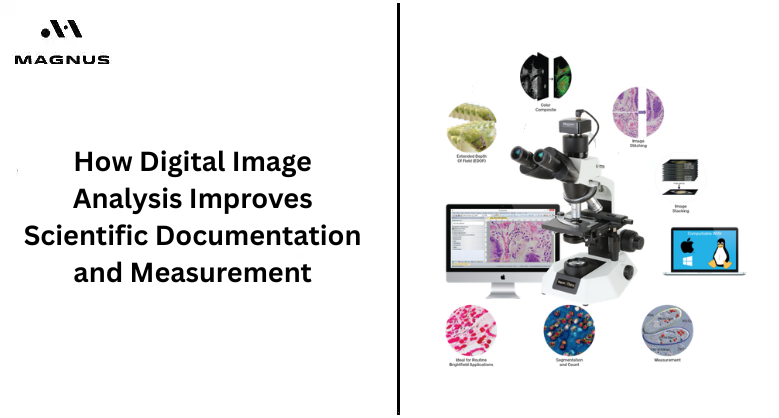
Magvision can support scientific image analysis through functions that help users:
- Get images from a compatible imaging system
- View acquired image
- Take dimensional measurements
- Add annotations
- Record observations directly on images
- Compare visual information
- Organise images for documentation
- Support repeatable measurement workflows
It can help to reduce handwritten notes and separate measurement data.
Converting Scientific Images into Information
A scientific image can carry a lot of information beneath its appearance. The tiniest variations in its dimensions, shape, structure, distance, and surface details may prove crucial for the study. Documenting these small details through observation alone can be challenging.
With microscope imaging software, scientists have access to information-rich images. The image itself serves as a source of information for the user, as they analyze specific parts of the image, measure distances, and document observation data on the same image.
The process might prove helpful to those who want to:
- Study microscopic structures
- Compare sample images
- Take measurements
- Analyze specific sections of the image
- Document observations
Improving Image Capture and Organisation
Accurate documentation begins with the best image capture. Poor organisation of photos might make it difficult to identify samples, compare data and recover data for future research.
Magvision, as the best digital image analysis software, offers researchers a methodical workflow for digital images. Researchers can interact with images without losing key sample and observation details. It reduces dependency on manual documentation and disconnected pictures.
The digital workflow will be helpful in
- Capturing systematic images
- Image evaluation
- Storage of visual information
- Comparing different observations
- Organizing research images
Systematic image capture and organization may help make them part of the research process.
Annotation and Labels for Better Research Records
A scientific image may have multiple sections that need explanations attached. Otherwise, researchers often have to consult different documents each time to understand what a certain section depicts.
Magvision's ability to annotate and label different parts of the image can help identify interesting sections. This will allow researchers to add more explanations to the image for later understanding.
Supports Consistent Microscopy Image Measurement
Performing repeatable experiments, measurement and documentation become critical tasks for the researcher. A consistent digital workflow can add structure to image analysis.
With Magvision, you can use existing measurement tools to record relevant dimensions from images. This approach minimizes the need to use different software for image viewing, measurement, and observation documentation. Consistent workflows can also support analysis of previously taken images.
Organising Visual Data for Future Reference
Many scientific experiments produce hundreds or thousands of images. When there is no organisation, finding specific images and observations can prove difficult. Magvision helps with visual data management by letting users manage images and related documents in a digital setting.
This helps the user access any previous observation with ease. This is especially important when the images are being captured in the lab, which require storage for future reference.
Streamlining Laboratory Imaging Workflows
Laboratory imaging software can support management of various phases of an image-based process in the digital world. With Magvision, this is made easier by incorporating image viewing, capturing and documenting into a single system.
Using Magvision, laboratory scientists can:
- Capture and review images
- Apply measurement tools to selected areas
- Add annotations for important observations
- Maintain image-based records for future reference
- Support consistent documentation across research activities
This systematic approach will keep the laboratory image-based process more organized and ensure images remain linked to the measurements and observations made from them.
Top Features of Magvision Software for Scientific Imaging
The table below shows how Magvision software supports various aspects of the scientific imaging process. The table shows how digitisation can bring imaging processes into order.
| Feature | How It Supports Scientific Work |
|---|---|
| Image Capture | Captures microscope images for digital observation and documentation. |
| Image Viewing | Provides an easy platform for reviewing captured images and identifying points of interest. |
| Measurement Tools | Provides dimensional measurements directly on images for microscopy-based analysis. |
| Annotation | Allows you to highlight important areas and add corresponding details to images. |
| Image Labelling | Assists in identifying the sample, structure or even region of the image captured. |
| Documentation | Assists in linking images to the information collected for future reference. |
| Scientific Analysis | Helps analyze images so researchers can document their findings visually. |
Wrapping It Up
Analyzing digital images can improve methodologies for scientific measurement and documentation. Digital image acquisition and visual documentation can improve the imaging process.
Magnus Opto Systems India Pvt. Ltd. offers Magvision software that helps in handling the latest requirements for microscopy and scientific imaging. If your laboratory needs reliable equipment for image acquisition, measurement, and scientific image documentation try Magvision.
FAQs
1. What is Magvision software used for?
The Magvision software is a scientific image acquisition and documentation program that helps scientists work with their image observations easily.
2. How does image-analysis software support scientific research?
Image analysis software enables scientists to analyze their visual data, take measurements, locate areas of interest and record their observations systematically.
3. Can microscopy software be used for image measurements?
Yes. Microscopy software offers digital measuring tools to evaluate various parameters such as dimensions and distance in the acquired images.
4. Why is digital image documentation important in laboratories?
Digital image documentation records visual observations with measurements and annotations for better accessibility and future reference.
5. How does image-analysis software improve?
Image analysis software optimizes scientific work by minimizing the manual procedures involved in image acquisition and documentation.