

Magnus CH20i Microscope: Applications in Education & Biological Labs
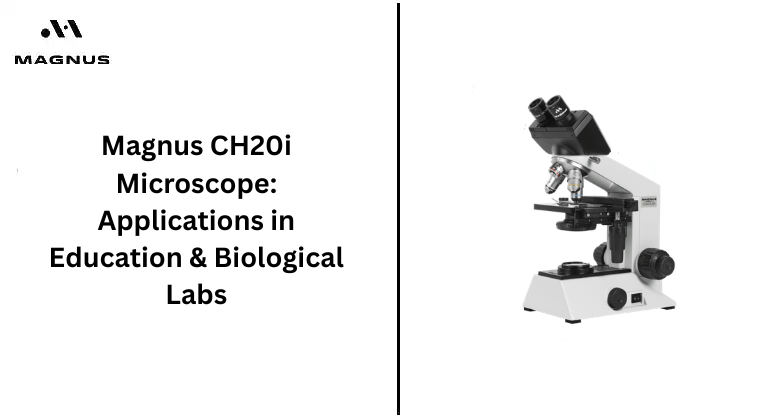
The microscope is an essential tool in the field of science, found in schools and laboratories, wherever objects and organisms are analyzed. The CH20i Microscope is popular for its high efficiency, outstanding image quality, and user-friendly design, making it well-suited for scientific and educational use. To observe the phenomena and facts taught to students, they require microscopes.
Moreover, scientists utilize microscopes during their work to study tissues, cells, and organisms. Modern biology education is highly dependent on practical work in labs, and the microscope is an important element of students' scientific training. Therefore, it is necessary for microscopes to be reliable and efficient in educational institutions. Let us dive into the blog to know the Magnus CH20i microscope: applications in education & biological labs.
Significance of Microscopes in Educational Settings
Microscopes have profoundly transformed science education, making learning interactive and experiential for students.
Assistance in Practical Learning
Students will be able to look at structures such as plant cells, bacteria, and tissues in their biology practical classes. This helps develop scientific knowledge as well as confidence in laboratory settings.
Improved Observation Skills
Microscopes enable students to focus and hone their analytical abilities by examining diverse biological forms.
Enhanced Student Engagement in Science Classes
The participation of students in science lessons will be increased through the practical use of microscopes in class.
Research Interest Development
Students get motivated to pursue careers in biological sciences, medicine, microbiology, and biotechnology by laboratory work.
Magnus CH20i Microscope Features
The CH20i microscope is a device meant to deliver accuracy, longevity, and comfort while being used in labs or class settings. The performance of its optics also qualifies it for educational and biological applications.
Significant features:
- Excellent optical clarity
- Good focusing capabilities
- User-friendly ergonomics
- Strong body build
- Evenly illuminated specimen
With the microscope, users can be able to do their observations easily in laboratory periods. It is easy to maintain, too, and hence fits well into educational institutions.
Uses of Microscopes in School Laboratories
In the laboratories of schools, microscopes are employed to acquaint students with the field of biology and microscopic organisms. Experiments are conducted by the teacher to impart knowledge to the students about living beings and the structure of plants.
Use of school microscopes:
- Observing plant and animal cells
- Observing microorganisms
- Tissue structure lab classes
- Scientific experiments and projects
The student microscope is an invaluable tool for beginners as it assists them in mastering the skill of specimen observation.
Application in Higher Learning
Microscopes are applied in the higher learning environment to conduct studies in advanced biology, microbiology, and other lab-based projects. Working with microscopes provides college students with better hands-on experiences as well as scientific knowledge.
Microbial Cultures Investigation
Students use microscopes during microbial cultures investigation and study of their characteristics.
Investigation of Cell Structures and Organ Systems
Microscopes help the learner in the study of cell structures and organs of the body during investigations in biological science.
Development of Laboratory Skills
Through practical preparation and investigation of specimens, students can develop skills for working in scientific laboratories.
Independent Learning Through Investigation and Projects
During project work and research done in universities and colleges, students require the use of microscopes for independent scientific thinking.
Microscopes that should be used in universities and colleges must contain features such as clear images and accurate magnification abilities.
Applications in Biological Laboratories
The biological laboratory depends on the microscope in the process of analysis for tissues, microorganisms, and cells. Magnification accuracy is essential in biological studies.
Applications in the Laboratory:
- Bacterial and fungal investigation
- Tissue sample analysis
- Cell analysis
- Microorganism identification
- Medical and biological research
The CH20i microscope operates effectively in biological laboratories where accuracy and magnification are highly required for laboratory processes.
Advantages of Modern Microscopes
Modern microscopes are advantageous since they provide more precision, user-friendliness, and better observations compared to older technology. Modern microscopes help learners, teachers, and researchers in conducting biological research effectively. With better optical performance, there will be increased chances of obtaining sharp images of specimens, hence effective analysis.
The modern microscope makes it easier to work with specimens since its usage is very convenient. Handling the instrument is made easier for learners, hence no stress in conducting biology experiments within the lab.
Improved functionality and user-friendliness help to obtain high-quality results from using the device. The presence of illumination enables users to observe the specimen with ease hence providing proper observations.
Institutions and biology laboratories require microscopes that can withstand rigorous tests and analysis, hence robust and reliable microscopes.
Importance of Image Clarity for Biological Microscope
Image clarity is one of the most significant considerations in using biological microscopes. Clear images make it easier for scientists to observe organisms.
Significance of Image Clarity
- It allows for better specimen visualization.
- It facilitates easy identification of microorganisms.
- It decreases errors in observations.
- It ensures accuracy in laboratory experiments.
- It supports biological studies.
A good biological microscope will ensure adequate light and magnification level.
Growing Demand for Advanced Educational Microscopes
Modern science education focuses heavily on practical and research-based learning. Educational institutions are investing in advanced microscopes to improve laboratory standards.
Factors behind the growing demand:
- Spread of knowledge in biology in laboratories and microbiology.
- Development of research in laboratories and microbiology.
- Requirements for precision instruments for scientific observations.
- Growing importance of learning through practical methods.
- Growing importance of medical and biotechnological studies.
- Improving standards of scientific research.
- Better opportunities for students' research work.
Durable and Suitable for Continuous Lab Experiments
The CH20i microscope is made to be used for extended periods in schools and biology labs. It is sturdy and maintains consistent optical quality, which makes it appropriate for use in practice classes and research.
This microscope can be used in lab work continuously without losing imaging quality, proper functionality, and reliability.
Final thoughts
The CH20i microscope is a dependable device for schools and laboratories that need precise visualization, robust construction, and ergonomic design. The brand Magnus is known to produce sophisticated microscopes and optical devices for scientific training and research purposes.
Customer service and installation services are some of the additional areas in which the company has been successful. Educational institutions seeking a microscope can approach them for dependable products and advanced laboratory equipment, along with professional technical guidance and reliable after-sales scientific support.
Frequently Asked Questions
Q1. What is the Magnus CH20i microscope used for?
The Magnus CH20i microscope is designed for biology education, laboratory training, microbiology, biological research, and routine specimen observation. It can be used to study cells, tissues, microorganisms, and prepared biological samples.
Q2. Is the CH20i microscope suitable for schools and colleges?
Yes. The CH20i is suitable for school, college, university, and medical education laboratories because it combines clear imaging, easy operation, ergonomic handling, and durable construction for regular practical sessions.
Q3. What can students observe with a CH20i microscope?
Students can use the CH20i to observe plant and animal cells, tissues, microorganisms, bacteria, and other prepared biological specimens. It supports practical biology lessons and helps students develop microscopy and observation skills.
Q4. Is the CH20i suitable for biological laboratories?
Yes. The CH20i can be used in biological laboratories for cell observation, tissue analysis, microorganism studies, bacterial and fungal examination, and biological research applications where reliable optical performance is required.
Q5. What magnification is needed for a student or biological microscope?
The required magnification depends on the specimen and application. Low magnification is useful for locating specimens and viewing larger structures, while higher magnification helps examine cells, microorganisms, and finer biological details.
Q6. How do I choose a microscope for a school or biology laboratory?
When choosing a microscope, consider optical clarity, magnification range, illumination, focusing controls, mechanical stage, ergonomic design, durability, and ease of maintenance. For institutions with frequent practical sessions, reliability and user-friendly operation are especially important.