

How Laboratory Microscopes Support Accuracy and Reproducibility in Scientific Research
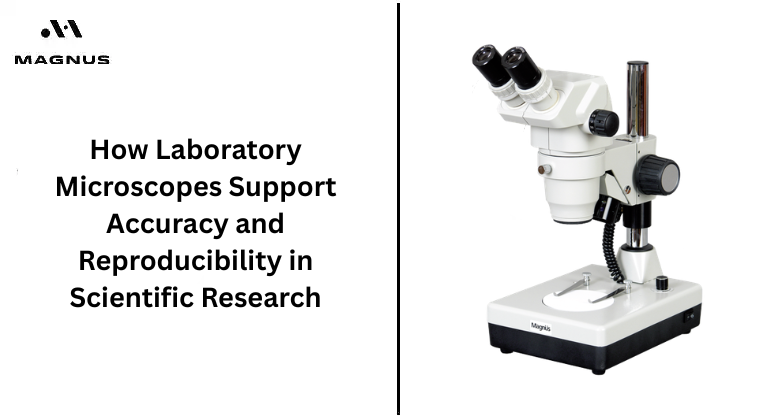
Scientific endeavors rely heavily on accuracy in observing, measuring, and documenting. Microscopes enable researchers to observe cells, tissues, microorganisms and any structures requiring magnification. Advanced optical instruments, measuring devices and calibration instruments ensure the accuracy of performed experiments.
Laboratory microscopes play an important role in biological, medical, environmental, educational and industrial research. Standardized observations and creation of digital records in structures result in the possibility of comparing results of different scientists and laboratories.
How Microscopes Ensure Accuracy
High-Resolution Optics
High resolution and high numerical apertures objective lenses can detect fine structural features. Scientists are able to distinguish the structural features of the cell, microorganism, tissue, and material. The magnification of an object helps the scientist to do scientific observation because it facilitates the observation of the object features.
Precision Measurement
A microscope provides accurate measurements through the ability of researchers to measure dimensions, structures, and cellular features of specimens. This process allows for comparisons of the samples observed in various stages of research.
Reduced Operator Variation
Inconsistency in visual references is reduced by the inclusion of automatic focusing, motorized Z-positioning, and digital imaging in the system. Consistency in focusing and positioning makes it possible for there to be visual consistency during future examinations. Visual consistency is made possible within the research group.
How Microscopes Enhance Reproducibility
Routine Calibration
Periodic calibration through standardized grids and measurement references allows for traceability of the measurement standards. Routine calibration enables consistent magnification, positioning, and accurate measurements over prolonged research periods. An appropriately maintained research laboratory microscope is thus able to give reliable results in subsequent experiments.
Standardized Protocols
Standard operating procedures ensure that researchers have consistent observation conditions for their experiments. A consistent laboratory process is composed of elements such as temperature control, vibration avoidance, light consistency, and specimen handling. Scientists may apply the same process for various specimens, experiments, and groups involved in research.
Digital Data Capture
With digital imaging techniques, one is able to capture, store, transmit and revisit their microscopic observations in an easier way. The images can contain data on the magnification, scale, specimen used among others.
Benefits of Microscopes in Scientific Research
Enhanced Visualization of Microscopic Structures
Microscope is the device used for observing small structures that need detailed observation such as cells, organelles, microorganisms, tissues, and surface of materials. Microscopes can provide observations of the nucleus, mitochondria, cell membranes, and other minute structures. This is helpful in sample examination in biological and material studies.
Helps in Medical and Pathological Study
Microscopes in scientific research are helpful in studying samples of blood, tissues, urine, and other biological materials. It allows observation of cellular structures, tissue changes, microbes and other details related to medical studies. Histopathology and blood smear studies are some examples of laboratory microscope studies.
Support for Cellular and Genetic Research
Through microscopy, researchers are able to look at cell division, mutation, protein formation, and cell interactions. Through fluorescent microscopy, researchers might be helped to see some proteins and cells in their research. These observations allow for genetic engineering, stem cell research, regeneration and many other scientific studies.
Research of Microbes
Laboratory microscopes allow scientists to observe microorganisms like bacteria, fungi, protozoa, etc. Microbe characteristics can be analyzed by scientists in samples of water, biological matter, food items, etc. Laboratory microscope applications are very significant in the fields of microbiology, infections, vaccine research, and food sciences.
Quality Control and Manufacturing Precision
Microscopes are used in industries in laboratories for the purpose of examining materials, components, and products in microscopic detail. They assist in recognizing characteristics that have something to do with the surface, structure, and production of various products like electronic components and pharmaceuticals.
Environmental and Forensic Research
Laboratory microscopy is useful in conducting environmental analysis on soils, water, plankton, microorganisms, and many others. Forensic laboratories carry out investigations using hair, fibers, biological fluids and other evidence under microscopes.
Role of Microscopes in Laboratory Testing
Medical Diagnosis
The microscopic analysis will help to identify and analyze features of cells and tissues. The blood smears may be used for identifying the characteristics of blood cells whereas the urine samples may be analyzed for crystals, cells, and microorganisms. The histopathological studies allow for the comprehensive analysis of biopsy specimens. Histopathology is also helpful for analyzing the diseases of the tissues.
Microbiology and Infection Studies
Biological samples stained for microscopic analysis allow the study of morphological features of bacteria and other characteristics of microorganisms. Scientists can make comparisons between structures of microorganisms and record their findings. Therefore, microscopy is helpful in microbiology studies.
Pathology and Histopathology
The biopsy sample serves as an important material for the determination of the cell structure, its growth pattern, inflammation, and degeneration. The scientists carry out research on the biopsies in order to know more about the disease. Repeated microscopic examination helps in comparing and enhances visual analysis of the pathology.
Medical and Allied Health Education
Microscopes in the laboratory make it possible for students to study the normal and abnormal characteristics of tissues and biological specimens under the microscope. These include red and white blood cells, epithelial tissues, bone cells, and other microscopic characteristics.
Summing Up
The use of laboratory microscopes is very important in obtaining clarity in science. Measuring and making repeatable observations were never more convenient. With the help of high-resolution optics, measurement tools, methods of calibration, standards, controlled environment and systematic recording the extraction of information becomes easy. This can be helpful in the areas of biological research, medicine, microbiology, environmental studies, forensics, education, and even industry testing.
The scientifically accurate microscopes of Magnus have been developed on the basis of precision optics, manufacturing, and usability. The ISO accredited production facility, high precision machines, experienced engineers, and strict quality standards ensure reliable microscope manufacturing by Magnus.
Explore the microscopes of Magnus to ensure precision and consistency in your scientific research.
FAQs
Q1. What are laboratory microscopes used for?
Microscopes are devices utilized in studying cells, tissues, microorganisms, materials and any other microscopic structure in many diverse fields of research.
Q2. Why are microscopes important in scientific research?
It provides thorough viewing of samples enabling one to take measurements, observe processes, compare results and carry out scientific investigations.
Q3. How can microscopy be used to conduct reproducible research?
Calibration, imaging, operating procedures and digital documentation contribute to achieving consistent results in research work.
Q4. In which areas is laboratory microscopy widely applied?
Laboratory microscopy finds its application in biology, medicine, microbiology, pathology, environmental studies, forensics, material science and many others.