

Hidden Costs of Low-Quality Microscopes: Why Optics Precision Matters
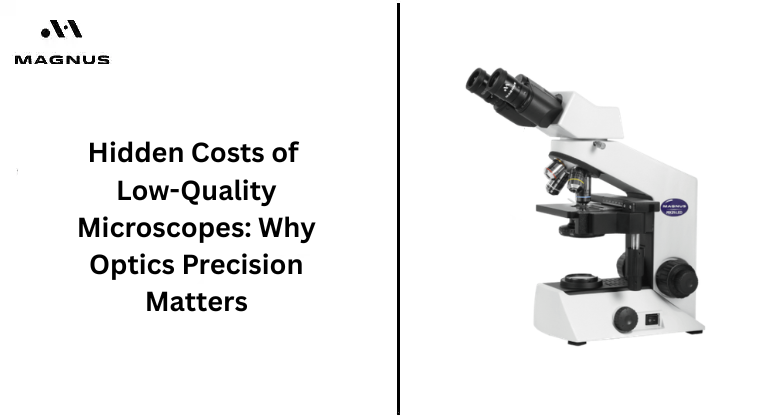
In the world of advanced science, many laboratories and industries are using microscopes to analyse microorganisms. The premium-quality microscope plays a crucial role in science, medicine, education and industrial inspection, which gives accurate data and helps in research and development.
Many industries considered buying a low-cost microscope, which appears to offer the same functionality as premium models for an affordable price. However, choosing a low-cost microscope with poor optical quality can create distorted images, poor colour accuracy and low-clarity pictures that make detailed observations difficult. These issues on scientific accuracy, additional repair and others raise a question on microscope quality comparison and productivity.
Let's dive into the blog to explore how using a low-quality microscope piles up hidden costs of repairs and guidance for finding premium optics precision.
Why Industries Are Into Buying Low-Price Microscopes
Whenever you plan to buy microscopes, the price tags seem extremely shocking. The identical models of low-quality microscopes seem tempting to choose, especially when you are on a budget. Though the cheap microscope advertises high magnification, like 1,000x or 2,000x, it gives low-optics images and puts all the work at risk.
In the microscope, the optical precision determines how clearly you can see small details of the sample, such as accurate measurements, and how long it can function. But the low-quality microscope pulls you into the pit and makes you pay a hidden cost every day. From wasting time and money to missing defects and repairs, it costs you for multiple reasons. Over a few years, those hidden costs can add up to far more than the price of a good microscope you could have bought in the first place.
Hidden Charges Of Buying a Low-Price Microscope
Here is the list of hidden charges the user faces when buying low-quality microscopes.
Illusion Of High Magnification
One of the biggest mistakes people make in buying microscopes is focusing only on the magnification numbers. A cheap microscope might claim 2,000x magnification, but often gives empty magnification. Without the optical precision microscope, the zoomed-in image might look blurry and pixelated.
A premium microscope shows the precise detail of the sample clearly without breaking. That is the power of quality lenses, which users can adjust the magnification of to get a clear optical image. The special glass and predictive coating of objectives make sure to give sharp images of every part, which the cheap objective fails to show in detail, even at lower magnification.
Lower Productivity
In the ever-growing world, time is money. Whenever you use a microscope with poor optics, you spend more time trying to see what you need and question the quality control system. It strains your eyes to focus through blurry edges and reinforces them as you move from the centre to the edge of the sample.
The low-quality microscope pushes users to spend more time getting sharp images and gives multiple takes to ensure they don't miss anything. It affects the individual's and the industry's productivity. Though it seems like a cost-effective solution, it can't stand near the premium microscope quality comparison. They help to speed up the inspection time with precision optics and help to find the need and move to the next sample.
Missing Defects And Rework
A microscope is equipment which helps users to get a precise view and image of objects that the human eye can't see. The low magnification support and low optics make the small defects unclear and fail to diagnose the contaminated particles in the sample.
The missing defects in the objects can put the users and the industries in critical positions. When the defect is discovered, they need to scrap it and rework it. For example, in industries, that defect can lead to customer returns, complaints, recalls, and damage to your brand reputation. The cost of one missed defect can be thousands, which is far more than the savings you thought you got from buying a cheap microscope.
Inaccurate Measurement
Many lab units use microscopes for measurement, counting cells and sizing particles. Using a poor-optics microscope can give distortion and field curvature in samples, which makes the measurements inaccurate and unreliable.
Such use of inaccurate data can cause bad decisions in experiments. That's why precision optics are essential for data integrity. It helps users to get an accurate measurement of images and push a successful experiment.
- Frequent Repairs And Downtime
Cheap microscopes are built with low-quality mechanical parts and inferior prisms. The lens elements can be shifted out of alignment over time and make the focus mechanism loose for images. The loose nosepiece and lens elements pull the microscope for more repairs, which maximises the work time.
Replacing a lab microscope costs between ₹ 5000 and ₹ 25000, according to models. The repair cost and labour use might add more cost and downtime to your work. The total spent on repairs and replacements over three to five years exceeds the price of a higher-quality instrument you could have bought upfront. It is far cheaper to buy well once than to buy cheap and repair often. - Outgrowing The Instrument Too Quickly
A low-cost microscope lacks the proper standard of DIN, which means it can't be replaced or upgraded. As the focus mechanism is too loose to hold calibration and poor optics make it grow out within months. When it happens, you need to buy a new microscope for further studies.
In these ways, despite saving money, you are extending your expenses. In contrast, buying a mid-range scope gives proper magnification and allows you to add phases, polarising filters and camera attachments whenever you need. The objectives themselves can cost more than the rest of the microscope.
How To Choose The Right Microscope
Before buying a microscope, make a note of your needs for it. Whether you are planning for quality inspection, advanced research or simple education, prioritise the microscope that uses optical glass lenses. Check that the objectives are achromatic at minimum and apochromatic for colour accuracy. Verify the mechanical quality of stable frames and smooth focus in a microscope.
Final Words
Low-quality microscopes make sound savings but deliver hidden costs in time, defects, repairs and quick outgrowths. Besides the microscope quality comparison, the precision optics are what make the microscope everything, so instead of considering prices, choose a microscope production that offers premium products and applications.
If you are looking for a premium microscope manufacturing unit in India, then visit the website of Magnus Opto, we deliver high-quality microscopes from teaching and compound microscopes to digital and fluorescence microscopes according to your needs. We provide precise optics and magnification that give long-term function and enhance productivity. Order your microscope on our Magnus Microscope website for quick delivery and enjoy its functionality.
FAQ
Q1. Why is my microscope image blurry even at high magnification?
A blurry microscope image is often caused by poor-quality optics, dirty objective lenses, incorrect focusing, or using magnification beyond the microscope's optical resolution. A microscope with precision optics delivers sharp, high-contrast images at every magnification level, making observations more accurate.
Q2. Is buying a cheap microscope more expensive in the long run?
Yes. While low-cost microscopes reduce the initial purchase price, they often lead to frequent repairs, poor image quality, inaccurate observations, lower productivity, and early replacement. Investing in a high-quality microscope helps reduce maintenance costs and improves long-term performance.
Q3. How can poor microscope quality affect laboratory results?
Poor-quality microscopes can produce distorted images, inaccurate measurements, and missed defects. These issues may lead to incorrect research findings, unreliable quality inspections, repeated experiments, and costly errors in laboratory or industrial applications.
Q4. What should I look for when buying a microscope?
Choose a microscope with high-quality optical glass lenses, achromatic or apochromatic objective lenses, stable mechanical construction, smooth focusing, reliable illumination, and upgrade options. Selecting the right microscope depends on your application, whether it's education, research, diagnostics, or industrial inspection.
Q5. Does higher magnification mean better image quality?
No. Higher magnification alone does not improve image quality. Without precision optics and high-resolution objective lenses, increasing magnification can result in blurry or pixelated images. Optical quality and resolution are far more important than magnification numbers.
Q6. Why do professional laboratories prefer premium microscopes?
Professional laboratories choose premium microscopes because they provide superior optical clarity, accurate measurements, consistent performance, and long-term durability. They also reduce operator fatigue, improve productivity, and deliver reliable results for research, diagnostics, and quality control.