

Inverted vs Compound Microscopes: Best Uses in Cell Culture & Pathology - Magnus Opto
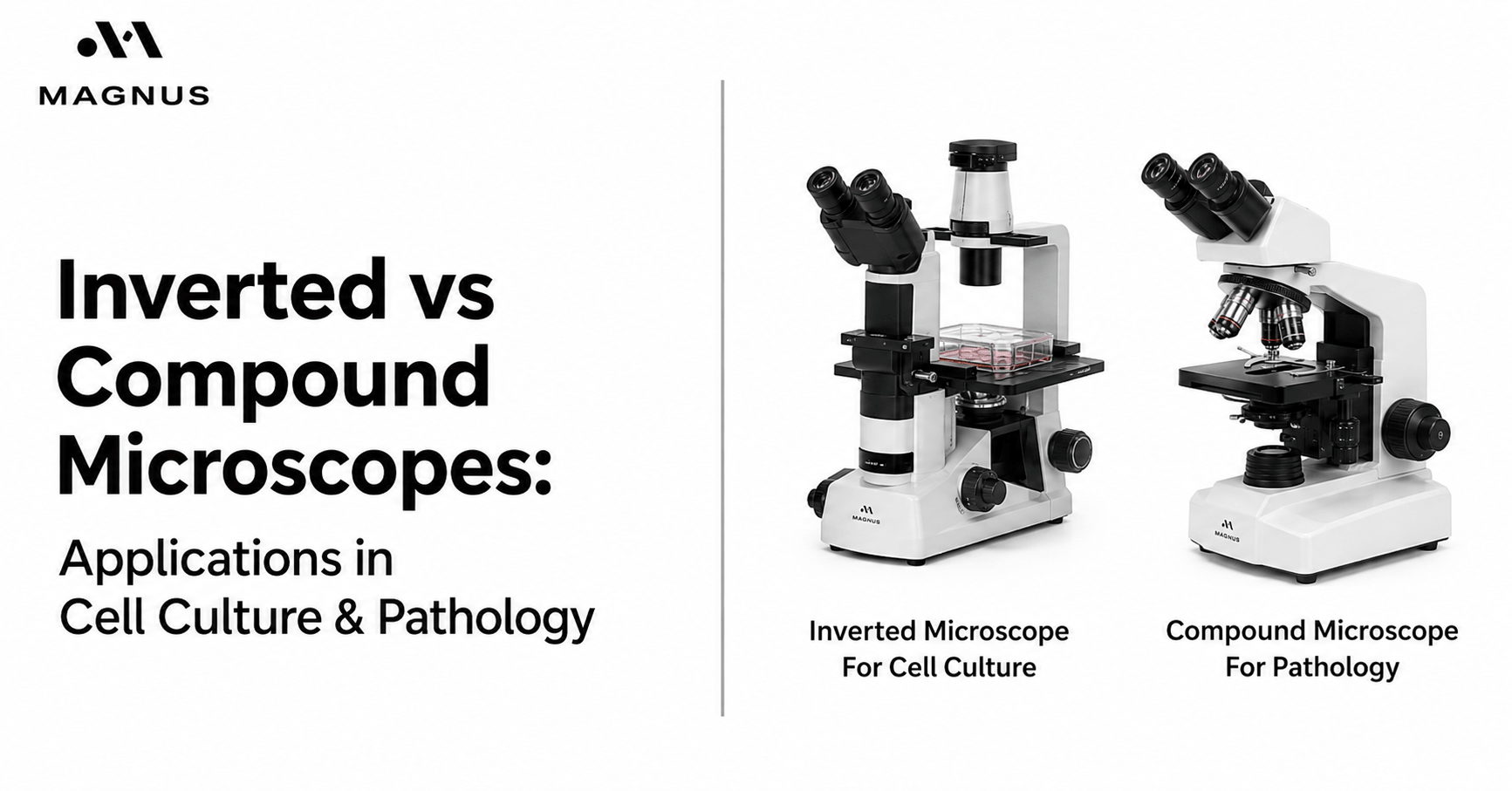
Microscopes are crucial tools in hospitals, laboratories, and research centers. These tools enable people to observe small organisms, tissues, and cells clearly. Choosing the right microscope can help increase efficiency and accuracy during observations. Some laboratories conduct comparisons of inverted and compound microscopes in order to determine which type of microscope suits them best.
The compound microscope is primarily utilized for stained specimens and pathology analysis. The inverted microscope is suitable for live cells and liquid analysis. An effective cell culture microscope promotes cell studies, and an efficient pathology microscope enables adequate tissue examination. This blog explains the applications of inverted vs compound microscopes in cell culture and pathology.
Compound Microscopes
A compound microscope is a very common microscope found in laboratories as well as in schools. This type of microscope makes use of many lenses that magnify tiny objects. Compound microscopes are used in viewing slides, bacteria, tissue, and stained specimens.
Compound microscopes are widely used by pathology laboratories for tests and diagnoses. The upright design helps users easily observe prepared slides. Compound microscopes are mainly chosen for viewing fixed samples and for detailed pathology work in hospitals and educational laboratories, compared to inverted microscopes.
Inverted Microscopes
The lenses are positioned below the stage, with the light source above the specimen, in an inverted microscope. The inverted microscope is designed to allow scientists to examine living cells from cultures without moving them from their containers.
Scientists usually make use of an inverted microscope for scientific studies. An inverted microscope can be used to study cell growth in culture over a long period. In the comparison between inverted and compound microscopes, the inverted microscope is regarded as more appropriate for current cell studies.
Inverted Microscopes vs Compound Microscopes
| Feature | Compound Microscope | Inverted Microscope |
|---|---|---|
| Lens Position | Above the sample | Below the sample |
| Sample Type | Thinly prepared slides | Cell culture dishes |
| Main Usage | Pathology studies | Live cell observation |
| Laboratory Field | Medical and education | Research and biology |
| Observation Style | Fixed samples | Living samples |
The inverted vs compound microscope comparison mainly depends on laboratory needs and sample type.
Applications in Cell Culture Laboratories
A cell culture laboratory should have a microscope that enables safe, clear examination of living cells. This is where the inverted microscope fits in, as it is capable of examining living cells inside their vessel without interfering with them.
It allows one to monitor ongoing events like cell division and growth. If designed well, the cell culture microscope may be able to prevent contamination during observation. These microscopes are often used in biotechnology and microbiology laboratories. The comparison between the inverted and compound microscopes in the former emerges victorious.
Applications in Pathology Laboratories
Pathology laboratories conduct studies of tissues, blood, and stained specimens to aid in diagnosing diseases. The pathology microscope provides high magnification and clarity for effective observation.
The compound microscope is commonly used and facilitates the examination of slides more efficiently. A pathologist can easily see any infections or tissue changes due to the high magnification. The use of compound microscopes remains significant in laboratory practice across most hospitals and medical laboratories.
Advantages of Compound Microscopes
- Provides strong magnification for clear viewing
- Suitable for stained tissue and blood samples
- Easy to use in schools and laboratories
- Supports regular pathology testing
- Works well for prepared slides
- Gives clear image quality for diagnosis
A compound microscope continues to support hospitals, schools, and scientific laboratories in many important applications.
Advantages of Inverted Microscopes
- Supports live cell viewing
- Allows viewing through culture containers
- Reduces disturbance to growing cells
- Useful for microbiology and biotechnology
- Suitable for liquid-based samples
- Helps researchers study cell movement
A modern cell culture microscope with an inverted design improves biological studies and laboratory research. Inverted microscopes provide better support for live cell work and advanced scientific applications.
Choosing the Right Microscope
The choice of the right microscope depends on the activities conducted daily in the laboratory. Compound microscopes are chosen by laboratories that conduct stained-glass experiments and tissue-based experiments. Inverted microscopes are used by research organizations that study living cells.
The budget, magnification requirement, and sample being examined can also play a role in choosing a microscope. The pathology microscope will be best suited to hospitals and diagnostics. The cell culture microscope should be preferred by researchers in biology and medicine.
Importance of Image Quality and Magnification
The quality of images is vital to applications such as medicine and scientific study. Good magnification helps the user observe small objects. Compound microscopes can provide clear images of tissues, and inverted microscopes assist in observing live cells without stopping.
Proper lighting and high-quality lenses enhance the performance of microscopes immensely. A good pathology microscope can be very helpful for diagnosing diseases. An excellent cell culture microscope enhances the quality of cell observation in laboratories. The clear images retain their importance in the comparison between the inverted and compound microscopes.
Future Trends in Modern Microscopy
The development of microscope technology continues to improve laboratory observations and scientific research. The current state-of-the-art technologies in imaging, high-end lenses, and automation enable rapid, high-clarity sample analysis.
Many laboratories integrate microscopes with cameras and computer programs to enable more accurate documentation. Scientists may also use advanced cell culture microscopy systems that facilitate extended observations of live cells. Pathology laboratories have begun to adopt digital pathology microscopes to achieve greater precision in their tests.
Winding Up
Inverted and compound microscopes are both useful when conducting laboratory observations and performing scientific experiments. The latter is very beneficial when dealing with stained specimens and pathology tests. Inverted microscopes are helpful for live-cell imaging and other types of biological research. An inverted vs compound microscope comparison allows laboratories to select the right type of equipment for their particular research requirements.
Investing in a good-quality cell culture microscope and pathology microscope leads to more accurate results. Magnus Opto offers the most innovative microscope solutions designed to fit the needs of the modern laboratory. We provide a wide range of high-quality microscopes with excellent imaging performance. Contact Magnus Opto today to find the right microscope solution for your research and pathology needs.
FAQs
1. What is the main difference between inverted and compound microscopes?
The main difference between inverted and compound microscopes is the lens position and sample type. A compound microscope has lenses above the sample and is used for prepared slides, while an inverted microscope has lenses below the sample and is used for live cells in culture dishes.
2. When should a lab use a compound microscope?
A lab should use a compound microscope for stained slides, tissue samples, blood samples, bacteria observation, and pathology testing. It is commonly used in hospitals, schools, diagnostic labs, and medical laboratories for clear viewing of fixed and prepared specimens.
3. What is an inverted microscope used for?
An inverted microscope is used to observe live cells, liquid samples, microorganisms, and cell cultures inside containers such as flasks, plates, and dishes. It helps researchers study cell growth, movement, and behaviour without disturbing the sample.
4. Which microscope is better for cell culture studies?
An inverted microscope is better for cell culture studies because it allows users to view living cells inside their culture vessel. This helps reduce sample disturbance and contamination while supporting long-term observation of cell growth and cell movement.
5. Which microscope is better for pathology laboratories?
A compound microscope is better for pathology laboratories because it provides strong magnification and clear imaging for stained tissue, blood, and prepared slides. It helps pathologists study infections, tissue changes, and disease-related sample details accurately.
6. How do I choose between an inverted and compound microscope?
Choose a compound microscope if your lab mainly studies prepared slides, stained tissues, and pathology samples. Choose an inverted microscope if your lab works with live cells, culture dishes, liquid samples, or advanced biological research.