

5 Essential Uses of Compound Microscopes in Pathology Labs | Magnus Opto - Magnus Opto
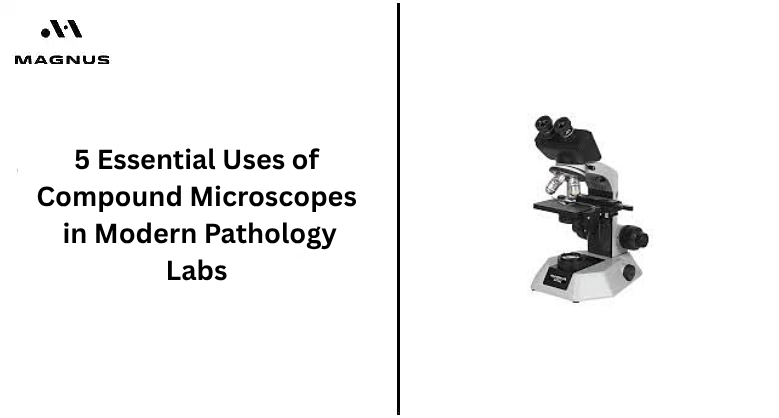
In today’s pathology labs, we find the usage of microscopes on a daily basis to study very small things that we cannot see with our normal eyes. The compound microscopes commonly used in pathology labs have different variances. This type of microscope has one lens, which helps us view small things in a larger size. By seeing things in a larger size, we can easily study our cells, bacteria, and other parts of our bodies. In this blog, we will learn about important uses of microscopes in pathology labs and their significance in medical science.
How a Compound Microscope Works and Its Importance
The compound microscope is able to achieve the aid of two very important lenses. It is very useful for the study of small parts that cannot be viewed normally. This helps experts to study the various diseases that affect the human body and understand the way the human body works. Compound microscopes are vital in hospitals and clinics for diagnosing human diseases and studying the human body.
5 Essential Uses of Microscopes
Identifying Microorganisms in Samples
Compound microscopes are used in pathology labs. These are used to find microorganisms. Such microorganisms as bacteria, fungi, and protozoa. These microorganisms remain invisible to the human eye. Lab technicians use the compound microscope to examine the microorganisms to diagnose the disease in its early stages. This is also used to identify the type of microorganisms present in the body. This is important for doctors to know, and they will know what is going on with the body. This will help the doctor to give the proper treatment to the patient. Experts use a microscope to examine the bacteria. Experts are able to identify the shape of the bacteria. Different bacteria have different shapes. Finding microorganisms is among the main microscope uses in laboratory environments.
Studying Blood Cells and Blood Disorders
The blood samples are tested to determine various diseases. These are infections, anaemia, and other blood-related complications. In the lab, blood is placed on a glass slide and special stains are applied to it. The blood is then viewed under a compound microscope after this preparation. The microscope assists the lab technicians in viewing the various blood cells, like red blood cells, white blood cells, platelets, etc. The lab technicians are able to view these cells and determine. Is the number of blood cells normal or not? If anything abnormal is noticed and it could be a sign of illness. If the number of white blood cells is extremely high, it could be a sign that the body is fighting an infection. Therefore, blood testing is an important aspect of microscope application.
Examining Tissue Samples
Histology is the study of the structure of the human body’s tissues with the help of a microscope. In pathology labs, tissue samples are carefully examined using compound microscopes. These tissue samples are obtained from the human body via biopsy or surgery. After the tissue sample is prepared, it is kept on the microscope slide. The compound microscope is used to study the tissue sample. This is an important tool for detecting diseases such as cancer and tissue infections. Doctors can understand the activities occurring within the human body by examining the cells present in the tissue sample.
Detecting Minerals and Other Substances in Biological Samples
A compound microscope is used to locate materials such as crystals and minerals in body fluids like blood and urine. In pathology labs, the patient's urine is examined using a compound microscope. The technicians use a compound microscope to examine crystals, bacteria and other unusual particles in the patients' urine in order to identify the disease. These particles are useful for identifying certain diseases, such as kidney stones and metabolic disorders. The doctors use the microscope to see small particles that cannot be seen under normal conditions. The microscope is usually used to examine body fluids and is useful in the medical field.
Supporting Medical Research and Scientific Studies
Compound microscopes are also used in diagnosing diseases. Compound microscopes can also be used in medical microscope research. Scientists also use compound microscopes in their experiments. Using microscopes, the scientist can observe the growth, division and responses of cells after the administration of various drugs. Scientists can learn more about the various diseases that affect the human body. In scientific research, compound microscopes are attached to cameras. By doing this, the scientist can take a picture of the specimen, which he/she can view later. Compound microscopes are very useful in scientific research.
Advantages of Compound Microscopes in Pathology Labs
Compound microscopes are widely used in labs because they provide several helpful advantages. The main advantage is their strong magnification. This type of microscope can enlarge small objects up to 1000 times for better visibility for scientists. Employing this type of microscope helps scientists view small structures inside cells. This type of microscope provides clear and detailed images. Its lenses are designed to deliver accurate and sharp results. Known as a compound microscope, it also comes with a built-in light source that helps illuminate the specimen. There are many medical microscope uses, as it helps doctors and researchers clearly observe cells, bacteria, and other microscopic structures for study and diagnosis
Why Pathology Labs Depend on Compound Microscopes
Pathology labs use compound microscopes and give clear views of the biological samples. It is hard to see the different microorganisms and cell structures without the use of a microscope. When doctors use a microscope to examine blood cells, they can identify different conditions and their effects on the body. This helps in the research that leads to various medical microscope discoveries. Compound microscopes have been significant in laboratories used today.
Final Thoughts
Compound microscopes play an important role in today’s pathology laboratories for researching difficult objects. Viewing and examining the cells, tissues, microorganisms, and crystals that cannot be seen with the naked eye helps doctors and scientists. The uses of microscopes are diagnosing infections, studying blood, and understanding disease development. Many laboratories prefer microscopes from Magnus Opto for their clear imaging and reliable performance. Their microscopes are designed for laboratory and research use, offering strong optical quality and durability for everyday scientific work. Explore the range of Magnus Opto microscopes today to find the right solution for your laboratory needs.