

Microscopes are the main component of industrial inspection, be it in quality control, electronics production, precision machining or material science. There are many versions of microscopes that are being used. But not all of those are created the same. Stereo Zoom Microscopes and Compound Microscopes are among the two most popular types applied in industry.
The right selection of an industrial microscope can have a big impact on your productivity and accuracy. This blog focuses on Stereo Zoom vs. Compound Microscopes, helping you understand which suits you the best.
What is a Stereo Zoom Microscope?
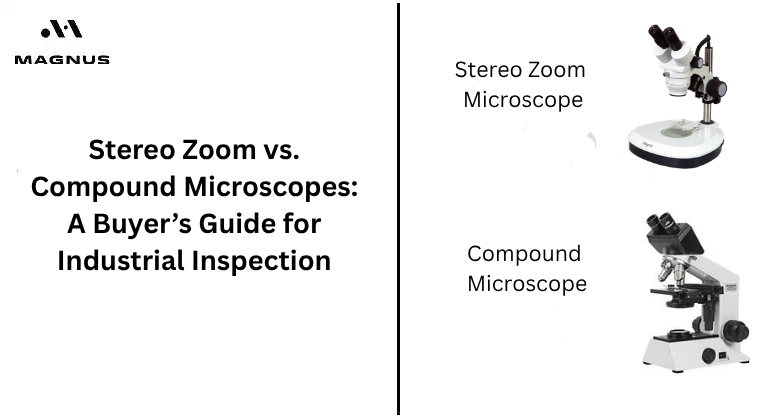
Stereo zoom microscopes are also referred to as a stereomicroscope or dissecting microscope. It offers 3D, upright and low-magnification views of large objects or specimens. It uses two separate optical paths and dual eyepieces to create stereoscopic images. This helps in allowing the user to explore the depth and structure of the specimen.
The magnification level of this microscope is from 6x to 50x. This makes it easier to adjust the zooming capacity and hold the focus while viewing the specimens.
Key Features of a Stereo Zoom Microscope
The following are the important features of a stereo zoom microscope:
3D Imaging
A realistic 3D image is produced by stereo microscopes and is particularly helpful in viewing the depth of objects or objects with intricate surfaces.
Level of Magnification
A normal magnification level is 6x through 50x, but there are models that have a little higher than this magnification with added lenses.
Working Distance
Their working distance is long, usually 20 mm to 150 mm, enabling users to manipulate the objects under the microscope during the observation process.
Lighting Capacity
Stereoscopic microscopes basically provide a reflected or incident light with a top-down view. This action illuminates objects. These lightings are used to test opaque materials like parts of metals, electronic components, and plastic assemblages.
Common Industrial Applications
Stereo zoom microscopes are popular in the industrial environment due to their ability to manipulate objects in real time as they are being viewed. It is used in industries like:
- Electronics inspection and soldering
- PCB (Printed Circuit Board) assembly verification
- Jewelry and gemstone inspection
- Mechanical part assembly
- Quality control in manufacturing
- Forensic and materials examination
As a whole, stereoscopic microscopes are highly useful when it comes to practical inspection due to their combination of 3D viewing and large working distance.
What is a Compound Microscope?
A compound microscope is used to view very small samples and specimens. This is done under a high level of magnification. Rather than generating a 3D image view, compound microscopes give a high-resolution, two-dimensional (2D) image with several objective lenses and transmitted light. They are designed for viewing thin, transparent specimens at cellular or microstructural levels.
Its magnification level ranges from 40x to more than 1000x. Unlike stereo microscopes, compound microscopes use a single optical path. It can have two or three eyepieces.
Key Features of a Compound Microscope
Now, let’s see the features of a compound microscope:
Multiple Objective Lenses
Compound microscopes have many objective lenses. These lenses are attached to a rotating turret. This structure allows users to change between magnification levels.
Transmitted Light Illumination
These are microscopes that work with the help of the light that goes through the specimen. This is the reason why the samples for these microscopes need to be thin or transparent.
Working Distance
Because of the high level of magnification, the objective lens is placed very near to the sample. Therefore, the working distance is short for this. It is less than a few millimetres, such as 2mm to 10mm.
Magnification Level
The magnification of compound microscopes is higher. It can be 40x to 1000x or even greater, which is why they are useful in the study of microscopic structure.
Common Industrial Applications
Compound microscopes are traditionally regarded as tools of biological studies, but they are also an important part of industrial inspection, especially in the examination of microscopic defects.
Typical uses include:
- Metallurgical analysis
- Material defect detection
- Fibre and textile analysis
- Pharmaceutical quality testing
- Microstructure examination
In these situations, the microscope’s ability to show extremely small details is very important and non-negotiable.
Differences Between Stereo Zoom Microscope and Compound Microscope
Let’s check how these two microscopes differ from each other:
| Feature | Stereo Zoom Microscope | Compound Microscope |
|---|---|---|
| Magnification | Low to medium (6× – 50×) | High (40× – 1000×+) |
| Image Type | Three-dimensional | Two-dimensional |
| Working Distance | Long (20 – 150 mm) | Very short (2 – 10 mm) |
| Lighting Method | Reflected light from above | Transmitted light through specimen |
| Specimen Type | Large, opaque objects | Thin, transparent samples |
| Best Use | Assembly, repair, inspection | Microanalysis, laboratory studies |
So, with this table, it is clear that a stereo microscope can be used for larger objects. On the other hand, a compound microscope can be used for very small objects that are invisible to our naked eyes.
Which Microscope is Better?
Now you know the reason each microscope is being used. Hence, it’s time for you to decide which one you need. Here are some of the suggestions to help your decision:
When to Choose a Stereo Zoom Microscope?
Stereo zoom microscopes are generally the preferred option for industrial inspection and manufacturing industries. You can get stereo zoom if you need:
- 3D view with depth perception
- Comfortable inspection for prolonged use
- A larger working space for tools or tactile tasks
- Rapid scanning of parts
- Visual inspection with minimal sample preparation
When to Choose a Compound Microscope?
A compound microscope is the right option when you are in need of high magnification and high analysis of very small structures. You can go for a compound microscope if you need:
- Ultra‑high magnification
- Detailed microstructural analysis
- Measurement of sub‑micrometre features
- Thin specimens fixed on slides
Final Words
Both stereo zoom and compound microscopes are wanted in industrial inspection. However, they are created with unique modes of analysis. Being aware of how they work will help you select the right microscope for your work system. Magnus Opto offers microscopes for industrial inspection and research purposes. Check our solutions to find the right fit for your industry needs!
FAQ’S
-
1. What is the difference between a stereo zoom microscope and a compound microscope?
A stereo zoom microscope provides a 3D view with low magnification (6x–50x), while a compound microscope offers high magnification (40x–1000x+) with a 2D image for detailed analysis. -
2. Which microscope is best for industrial inspection?
Stereo zoom microscopes are ideal for assembly, repair, and surface inspection, whereas compound microscopes are better for micro-level analysis and detecting fine defects. -
3. When should I use a stereo zoom microscope?
Use a stereo zoom microscope when you need a 3D view, longer working distance, and the ability to handle larger or opaque objects during inspection. -
4. When should I use a compound microscope?
A compound microscope is suitable when you require high magnification to examine very small, thin, or transparent samples like fibres, cells, or microstructures. -
5. What is the magnification range of stereo and compound microscopes?
Stereo zoom microscopes typically range from 6x to 50x, while compound microscopes range from 40x to over 1000x.