

Advanced Live Cell Imaging: When to Choose an Inverted Microscope
Microbiologists conducting research need to observe live cells that are still growing. This is when these individuals need tools that allow them to observe these cells clearly without disturbing them.
This is when an inverted microscope is particularly useful for these individuals, as it differs from many other microscopes. They can purchase for their research as it enables them to observe live cells directly in culture dishes or flasks. This microscope is very useful for advanced live cell imaging. This microscope is highly versatile and can be used for cell culture work, drug screening, microbiology, and tissue analysis in different laboratories.
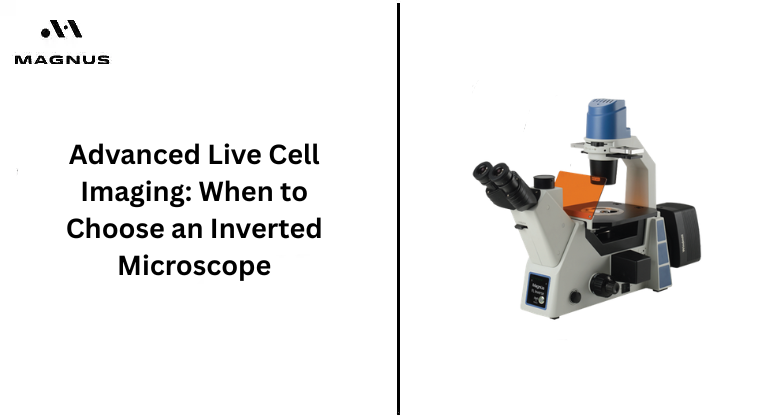
In such a microscope, the objective lens is located below the stage while the light source is above the specimen. This makes it easy for these individuals to observe their samples that remain at the bottom of containers, such as petri dishes. This blog will address when an inverted microscope is necessary for advanced live cell imaging.
Understanding Advanced Live Cell Imaging
This is a method for observing living cells at a given time as they continue to develop normally. Scientists can also witness processes like cell division, cell movement, and cell interactions. Obtaining accurate results requires a scientist to have microscopes that observe living cells without harming them.
An inverted microscope is a great tool for observing living cells, as it allows them to remain in the culture medium while being observed. This is a very important method for observing biological changes.
What Is an Inverted Microscope
An inverted microscope is a microscope with a different structure compared to a normal microscope. In this microscope, the objectives are arranged at the bottom where the sample is kept on the stage. The light source and the condenser are arranged at the top, where the sample is kept.
This allows the scientists to view the samples from the bottom of the vessel instead of the top. This greatly eases the visualization of the cells that are cultured in dishes, flasks, and plates without the need to place them on a slide. The inverted microscope price is greatly beneficial in the study of living specimens.
How Inverted Microscopes Support Live Cell Studies
Living cells are usually found at the bottom of the culture dish or flask. An inverted microscope helps to observe these cells without disturbing them. Scientists can easily study cell growth, shapes, and movement under normal conditions. Some of these microscopes also include temperature chambers and carbon dioxide chambers. This helps cells survive long observation times. These inverted microscopes are very helpful for experiments that require continuous monitoring.
Key Applications in Research Laboratories
Inverted microscopes are used across many scientific disciplines. Some common uses include,
- Monitoring cell cultures
- Studying stem cells
- Tissue engineering research
- Observing microorganisms and parasites
- Drug testing and pharmaceutical studies
Researchers can also observe tissues, cells, and microorganisms directly in their culture containers. These inverted microscopes have become an important instrument in modern life science laboratories.
Advantages of Using an Inverted Microscope
The advantage of an inverted microscope is that scientists can study living cells. They remove them from their cultural environment. This lowers the chance of contamination or damage. Other benefits include,
- Ability to observe thick or large samples
- Easy access to the sample from the top
- Better viewing of cells growing in dishes
- Less sample preparation
These advantages make inverted microscopes very useful for long laboratory experiments.
Comparison of Inverted vs Upright Microscope
Knowing the difference will help determine whether the two are appropriate for the purpose. For upright microscopes, the objective lenses are located above the specimen. The light source is located below the specimen.
This type of microscope is mostly used for viewing a specimen placed on a slide. On the other hand, the inverted microscope has its objective lenses below the specimen. It is most appropriate when one wants to observe a specimen in a liquid container.
Imaging Techniques Used with Inverted Microscopes
Modern inverted microscopes support several imaging methods used in laboratories. These include,
- Brightfield imaging
- Phase contrast microscopy
- Fluorescence microscopy
- Differential interference contrast (DIC)
Phase contrast imaging helps scientists observe transparent living cells without any stains. Fluorescence imaging helps scientists observe particular parts of cells by adding fluorescent markers. These imaging techniques help scientists observe complex biological processes in greater detail.
Factors to Consider When Choosing an Inverted Microscope
Selecting the correct microscope depends on several important factors.
- Type of research work
- Required magnification level
- Imaging techniques needed
- Budget and laboratory space
Researchers should check the microscope supports digital cameras, analysis software, and environmental control systems. Choosing the correct microscope helps laboratories achieve accurate results and improve workflow.
Limitations to Be Aware Of
Even though inverted microscopes provide many advantages. They also have a few limitations. They are higher in cost than upright microscopes and may require careful maintenance. Some culture vessels with thick bottoms can slightly affect image clarity.
In some cases, special objective lenses may be needed for better observations. The benefits of inverted microscopes for live cell imaging often make them the preferred choice in many laboratories.
The Future of Inverted Microscopy in Life Sciences
In addition, the technology used in microscopes is advancing. New inverted microscope systems have automated imaging, digital analysis, and imaging software. These new features enable the capture of more images, the study of cell behavior over time and more efficient biological research. The inverted microscope price is vital to biological research.
Wrapping up
For advanced live-cell imaging, microscopes need to be acquired that not only allow scientists to study their samples but also do not interfere with them. In most research centers, the inverted microscope has been the most popular instrument for scientists.
It allows them to study specimens directly in the containers in which they were cultured under normal conditions. If the two microscopes are compared, the inverted microscope will have more advantages over the upright microscope.
It is a wise move for one to buy an inverted microscope for cell culture research. Other factors to consider include the price of the inverted microscopes, the scientists' requirements, and the microscopes' ability to perform the required task. Some of the best microscope manufacturers, such as Magnus Opto, have developed the best microscopes, such as the INVI series.
FAQ:
1. What magnification is used for live cell imaging?
Live cell imaging typically uses 10× to 100× objectives. Lower magnification helps track cell movement, while higher magnification provides structural detail. Selection depends on cell size and experiment goals.
2. What numerical aperture is ideal for cell imaging?
An NA of 0.4 to 1.4 is ideal for live cell imaging. Higher NA improves resolution and light capture. Oil immersion lenses provide maximum clarity but require careful handling.
3. Why use phase contrast in live cell imaging?
Phase contrast enhances transparent cells without staining. It converts phase shifts into visible contrast. This allows continuous observation while maintaining cell viability.
4. What environment is needed for live cell microscopy?
Live cell imaging requires ~37°C temperature, controlled CO₂ levels, and humidity. These conditions maintain cell viability during long observations and prevent experimental errors.
5. Are inverted microscopes used for fluorescence imaging?
Yes, inverted microscopes support fluorescence imaging using filters and light sources. This enables visualization of labeled cell components with high specificity.
6. What camera is best for live cell imaging?
sCMOS cameras are commonly used for live cell imaging. They offer high sensitivity, low noise, and fast frame rates, making them suitable for dynamic cellular processes.
7. What is the resolution of optical microscopes?
Optical microscopes have a resolution limit of ~200 nm. This depends on wavelength and numerical aperture. Higher NA improves resolution within diffraction limits.