

Microscopes are essential scientific tools that allow us to observe objects too small to be seen with the naked eye. Researchers, students, and scientists use microscopes to study tiny structures such as cells, tissues, and microorganisms. These instruments play an important role in laboratories, classrooms, and research environments.
Among the different types available, the two most common are simple microscopes and compound microscopes. Both help magnify small objects, but they work in different ways and are used for different purposes. Knowing these differences can help in choosing the right microscope. This blog explains how they work and how they perform.
What is a Microscope
A microscope is a tool designed to magnify very small objects. It allows us to see things that are too tiny to be observed with the naked eye. Microscopes are commonly used in laboratories, hospitals, and classrooms. Some microscopes use a single lens to magnify objects, while others use multiple lenses. These two types are the most commonly used in scientific studies.
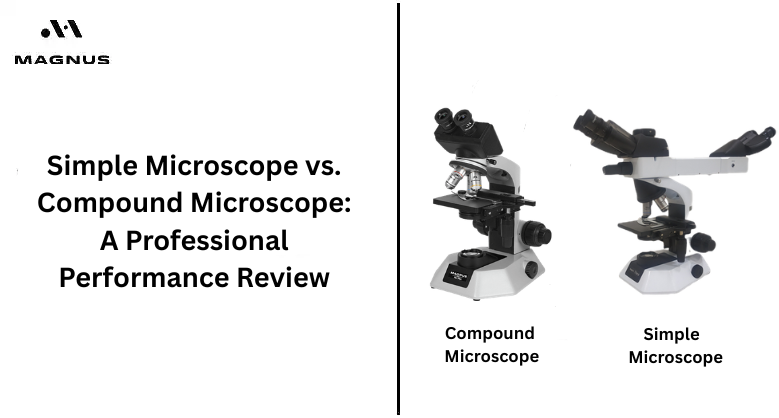
Their shapes differ, each shaped by how big or compact they need to be. What something looks like up close depends on its visible scale through the lens. Spotting each piece of these tools matters because it helps users see tiny details more clearly.
What is a Simple Microscope
A simple microscope is a basic optical tool. This lens makes things look bigger. It's just like a magnifying glass. Light bends through it, so the image seems larger. Small microscopes help with quick checks. They're good for simple tasks. It seems useful for everyday use. Plus, they don't need much setup.
Jewellers, watch repair workers, and students use them to see tiny parts clearly. They are easy to use and require no complex settings. The magnification of a simple microscope is usually small. Most simple microscopes make objects about 2x to 20x bigger. Because the design is simple, they are light, low-cost, and easy to carry.
What is a Compound Microscope
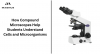
Compound microscopes build on simple ones. They use two lenses to make things look bigger. One lens, the objective, first makes the image larger. Then the eyepiece takes over. Making it even bigger. They work well in labs and research spots. Scientists use them to spot tiny things like bacteria or small bits.
Zoom goes from 40x to 1000x. This helps catch small details clearly. Probably best when you need to see what's really small. The result is clearer than with simple tools. But it still depends on setup and lighting. Plus, results can vary a bit. It seems like the best choice for detailed work.
Lens Structure and Optical Design
How many lenses do they have? A simple microscope has just a single convex lens. When you place an object in front of it, the lens makes things look bigger. It's easy to use and keep clean. A compound version uses more than one lens. The objective is to make the object appear larger.
A compound microscope, on the other hand, uses multiple lenses. This system of many lenses improves image quality and detail. This design of compound microscopes produces clearer, sharper images.
Magnification and Image Quality
Magnification means making an object look bigger and identifying the tiny objects. It is an important feature of a microscope. Simple microscopes give low magnification. They are good for objects that need only a small enlargement.
Compound microscopes give higher magnification. They help users to see cells, bacteria and other very small parts clearly. The total magnification is found by multiplying the objective lenses. The magnification is by the eyepiece lens's magnification. The combined power of microscope is higher.
Simple Microscope Formula and Magnification Principle
The working of a simple microscope can be explained using the simple microscope formula. The formula is written as,
M = 1 + D / FIn this formula,
M means magnifying power, D means the least distance of clear vision, and F means the focal length of the lens.
If the focal length is shorter, the magnifying power increases. This makes the object look larger through the lens. This idea explains the magnification of simple microscope and how lenses change the image size.
Working Principle of a Compound Microscope
A compound microscope works in two magnification steps. First, light passes through the condenser and reaches the specimen. The objective lens then makes a larger image of the object. The eyepiece lens makes the image appear larger to the viewer.
Compound microscopes provide clearer and more detailed images. The power of a microscope is greater than that of simple microscopes.
Common Applications of Simple Microscopes
Simple microscopes are used in many daily tasks. They can be quite handy for quickly and easily viewing small objects. Students make use of them in their classrooms to understand the concept of magnification.
Jewellers also make use of them to check small gemstones and pieces of jewellery. Watch repair workers also make use of them to view small machine parts in the fields of farming and biology. They help us see small insects and plant parts.
Applications of Compound Microscopes in Research
Compound microscopes are important in scientific research. They help scientists study microorganisms, bacteria and cells closely. The researchers use them to see cell structures and tissues in biology labs.
Medical labs study blood samples and microorganisms. They are also used in forensic science to examine very small evidence samples. Their advanced compound microscope design provides high magnification and improved image clarity.
Key Differences in Professional Performance
Both microscopes are useful, but their performance is different. Simple microscopes are easy to use and cost less. They are good for basic observation work. Their magnification and image clarity are limited. Compound microscopes are advanced tools.
They give higher magnification, better resolution, and improved lighting systems. These features make them suitable for laboratory work and professional research. The choice between these microscopes depends on the level of detail the user needs.
To Sum Up
Both simple and compound microscopes play significant roles in science and education. A simple microscope is useful for general purposes. A compound microscope is designed for scientific purposes. Knowledge of the simple microscope formula and its structure is useful for selecting the right type of microscope for specific purposes.
Magnus Opto provides microscopes for effective viewing and results. Its microscopes are useful for learning purposes, laboratory work, and research. Explore the microscope range from Magnus Opto today and improve your observation with trusted optical technology.