

Precision Measurement: How to Calibrate Using Stage & Eyepiece Micrometres
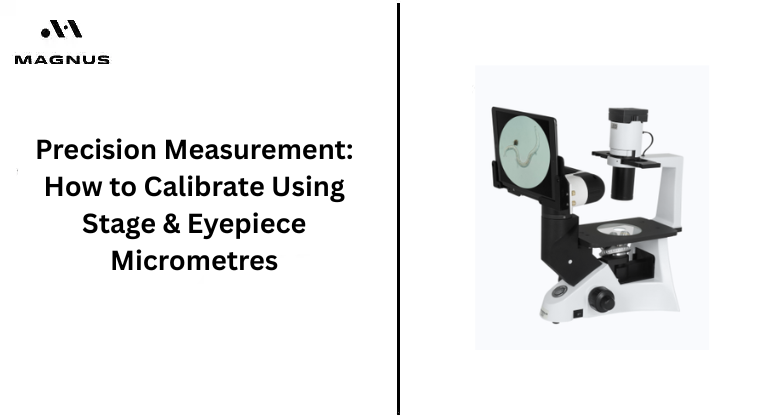
A microscope helps scientists and lab technicians see and identify small objects. It is one of the most widely used tools in labs worldwide. Cells, bacteria, and many other microscopic objects can be seen with a microscope. However, it is not always enough to simply see these objects.
There are times when these objects also need to be measured. And that's where the calibration of a microscope becomes important. Calibration helps us see the actual sizes of objects as compared to their sizes under a microscope. Without calibration, measuring objects can easily lead to incorrect results, as magnification can vary with different objective lenses.
These tools are useful for scientists to convert measurements from the microscopic scale to real-world measurements. In any lab, across the world, stage micrometre and eyepiece micrometres are generally used during calibration. These tools are also considered essential tools for any lab that requires precise measurement.
Why Microscope Calibration is Important
A microscope is a device that is used for magnification. We can see the objects clearly when they are put in a microscope. The magnification of the microscope changes the size of the object in such a way that it is visible. What we see does not necessarily indicate the size of the object.
Calibration helps to resolve the issue. Calibration helps the scientist relate the scale on the microscope to the actual measurement scale. In some fields, such as biology, medicine, and materials, measurement is very crucial. A scientist may be required to measure the diameter of a cell or the length of a bacterium. Without the correct measurement, the results may be incorrect.
Understanding the Stage Micrometre
A stage micrometre is a special type of microscope slide that contains a very small measuring scale. At first glance, it looks like a regular glass slide. But instead of holding a sample, it has a finely printed scale. Most stage micrometre have a scale in which 1 millimetre equals the total length.
This scale is normally accurate and thus serves as a reference scale during calibration. When the stage micrometre is placed on the microscope stage, the scale is normally visible through the microscope. The scale is then compared to the eyepiece scale.
What is an Eyepiece Micrometre
An eyepiece micrometre is essentially a glass disc with markings on it and it resembles a circle. It remains attached to the eyepiece of the microscope. The markings are placed over the object when viewed through the microscope.
In contrast to the stage micrometre, the scale is not calibrated to any measurement units. Each unit length depends on the magnification level that is used. Before using the eyepiece micrometre, calibration is a must. Upon calibrating, the scale can specify the length corresponding to each unit.
How the Two Micrometres Work Together
The stage micrometre and eyepiece micrometre are designed to work together during calibration. The stage micrometre provides a scale with known measurements. The eyepiece micrometer provides a reference scale that appears in the microscope view. During calibration, both scales are aligned so they overlap in the microscope field.
By comparing the number of divisions on each of the two scales, the scientists are able to determine the actual measurement value of each eyepiece's division. After this process, the eyepiece micrometre is ready for the actual measurement of the object using the microscope.
Tools Needed for Calibration
The calibration process does not require complicated equipment. Only a few basic items are needed. These include,
- A compound microscope
- A stage micrometre slide
- An eyepiece micrometre
- Objective lenses
- Standard microscope slides
These microscope accessories work together to ensure the microscope provides precise measurement results. The stage micrometre is the reference scale and the eyepiece micrometre. It enables the measurement to be read during observation.
Basic Steps in the Calibration Process
The calibration process is a straightforward sequence of steps. The microscope used the micrometre rule to identify easily, and its stage. The microscope accessories should be set up in the proper position. The scale on the slide is visible and can be frequently checked if necessary. It is clear and easy to read due to its features.
The eyepiece micrometer is firmly fixed inside the eyepiece. If you look through the microscope, you should be able to see two scales. The zero of the eyepiece scale should be aligned to the zero of the stage micrometre scale. Gradually move along the scales to align the two lines again. The two sets of identical lines will be used to determine the measurement value.
Finding the Measurement Value of the Eyepiece Scale
The scales are aligned and the matching marks are identified. To calculate the value of each division on the eyepiece scale. Imagine 30 divisions on the eyepiece scale and it matches 20 divisions on the stage scale. If one division on the stage scale equals 10 micrometres.
Another 20 divisions represent 200 micrometres. To find the value of one eyepiece division, divide 200 micrometres by 30 divisions. The result gives the actual size that each eyepiece division represents. This calculated value is later used when measuring microscopic objects.
Applications of Micrometre Calibration
Micrometre calibration is used in a variety of fields. Biology labs are used for the measurement of cells, bacteria, etc. Pathology labs are used when studying blood cells or tissue. Industrial research labs are used by scientists to measure the sizes of particles, fibres, etc. The measurement of the object is critical for the processes of testing or quality.
Helpful Tips for Accurate Calibration
A few simple practices can improve calibration accuracy. Start the calibration process with the lowest magnification lens. This makes it easier to align the scales clearly. Make sure both scales are properly focused before comparing them. It is also helpful to record calibration values for each objective lens for later use. Finally, handle micrometre slides carefully because they are delicate laboratory tools.
Final thoughts
Another important aspect to consider during microscopic observation is measurement. This aspect is important since, without measurements, the object's actual size under the microscope does not necessarily reflect its actual size.
By using the stage micrometre as a standard and comparing it with the actual eyepiece micrometre, scientists can determine the actual size of the microscopic object. For any laboratory seeking the best and most reliable microscope equipment, Magnus Opto offers the most accurate microscopes for collecting scientific data.