

How Stereo Microscopes Assist in Forensic Examination and Trace-Evidence Analysis
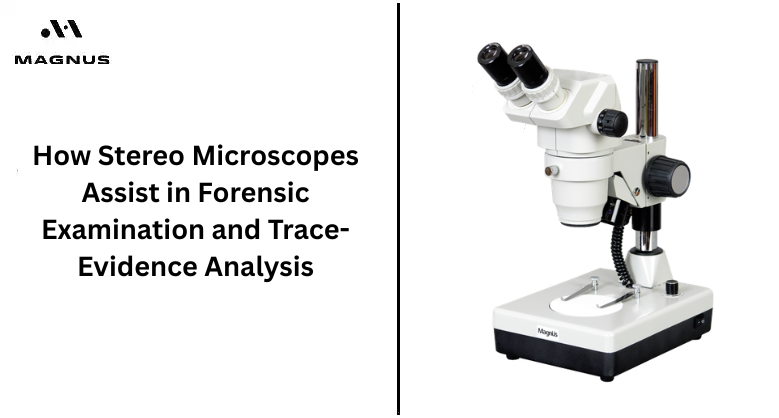
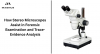
Stereo microscopes are very crucial in forensic work due to the fact that they allow the user to examine the evidence through magnification and depth of field. They have two optical systems that allow the formation of a three-dimensional image to aid forensic scientists in the examination of the specimen surface features.
They become very useful in analyzing specimens that are coarse, opaque, and delicate in nature. Moreover, the large working distance allows for ease in manipulation and examination of the samples by the examiner. Some of the things that can be examined through the stereo microscope include hairs, fibers, paints, documents, residues, and toolmarks.
How Stereo Microscopes Work in Forensic Investigations
The stereo microscope uses two independent optical systems that give different angles to the two eyes. The images produced from these optical systems are combined by the brain, creating a three-dimensional image, thus allowing for enhanced depth perception.
Forensic practical examination usually employs magnifications ranging from 4X up to 40X. However, some instruments can be used to achieve even greater magnifications. The extended working distance ensures that there is enough room for handling specimens during examination.
The wide field of view also helps to have an overview of the evidence prior to any microscopic and chemical examination. Reflected illumination is useful in viewing solid and opaque samples, while transmitted illumination can be used on translucent samples.
Optical Features of a Stereo Microscope
The stereo microscope is used in forensic science, and it has some optical characteristics that make the process of examination easier.
- 3D Visualization: There are two optical paths, which facilitate the visualization of the surface topography and contours.
- Long Working Distance: The long distance between the objective lens and specimen enables safe manipulation, sorting, moving, and examination.
- Large Field of View: Lower magnification gives a wider view of specimens before they are examined at high magnifications using other analytical techniques.
- Reflected and Transmitted Light Microscopy: Using different types of light microscopy is useful when observing details of specimens based on their properties.
Key Forensic Applications
The stereo microscope applications extend across several areas of forensic examination. The optical characteristics enable forensic scientists to examine the physical features, surface features, and structure of the minute object.
Sorting of Trace Evidence
The microscopic analysis is also used in examining trace evidence such as hair, soil particles, fiber, glass and other small bits of debris.
Fiber and Hair Analysis
Fiber analysis is beneficial for understanding the surface morphology, structure, color, and other physical features. Similarly, hair samples can be analyzed for their surface features and structures.
Paint and Coating Analysis
The stereoscopic microscope is helpful to examiners in examining paint chip and coating fragment samples. Layers, coloration, fracture patterns, and layering can be observed, thus facilitating comparison between paints used in automobiles and households.
Gunshot Residue and Ballistics
Evidence related to gunshot can consist of bullet fragments, cartridge casings, primer residue, and individual particles. Magnification allows the identification of such materials along with their physical attributes.
Tool Marks and Impressions
Tool marks may have striations, scratches, impressions, and other surface characteristics. Careful optical examination allows investigators to analyze these characteristics on items and compare patterns that are evident from various tools or weapons.
Document Examination
Documents with questionable authenticity may exhibit overwriting, erasures, stacking of ink, disturbances in paper fibers, and color changes. Surface examination will assist in the detection of these physical features without making the document unavailable for further examination.
Fingerprints and Forensic Entomology
Magnified examination will facilitate the study of ridge features, development of latent prints, and interaction of prints with substrate. In forensic entomology, insect features and life stage features may be studied for species identification and determination of time of death.
Role in Trace Evidence Analysis
Stereo microscopy for trace evidence provides a practical approach for examining small materials according to their visible physical characteristics. Examples of materials which can be categorized and analyzed before going ahead for further analysis include fibers, hair, glass, soil, paint, residues, and many more.
This three-dimensional view helps the examiners to get information about the depth of the sample materials in the surface that is uneven. This view is especially important for samples with an uneven surface.
Supporting Accurate Evidence Examination
Forensic microscopy applications include initial analysis of several different types of evidence. It is possible to use magnification for the purpose of finding tiny particles, analyzing the surface characteristics, comparing the characteristics visible and preparing samples for further analysis.
Evidence documentation may also be a component of examination using images and observations. Digital imaging equipment coupled with proper microscopes may provide magnified images for comparison, documentation, and reporting purposes.
3D viewing allows studying the structure in depth and its orientation. Such visual information gives forensic examiners a clearer understanding of physical evidence during preliminary assessment.
To Sum Up
The stereo microscope is an excellent instrument for forensic laboratories offering an optical technique for the investigation of small, opaque and three dimensional objects. Its three dimensional depth of vision, wide field of vision, large working distance and versatile illumination help in the investigation of fibers, hair, paints, residues, tool marks, documents and other materials.
Non-destructive examination helps in keeping the physical features intact for further analysis. The forensic laboratory investigation can hence become highly useful due to accurate observation and efficient handling of evidence.
Magnus combines science, optics, strict quality control and manufacturing to deliver reliable microscopy solutions. Learn more about Magnus microscopes and enhance your forensic investigations using optical observations.
FAQs
Q1. How is a stereo microscope used in forensic science?
It enlarges physical evidence so that there is depth perception of fibers, hairs, residues, papers, fragments and surfaces.
Q2. What types of trace evidence can be examined through stereo microscopy?
Hair, fibers, soil, glass, paint, residues, bullets, and various other microscopic items may also be tested.
Q3. Why is three-dimensional viewing helpful in forensic analysis?
It brings out various characteristics like depth, texture, shape, structure and patterns on the surface of the object under observation.
Q4. Is non-destructive testing possible with stereo microscopy?
Yes, since it permits thorough optical testing of objects and preserves them for future testing.
Reference
https://mtesolutionsinc.com/blogs/default-blog/the-stereo-microscope-in-forensic-applications
https://microscopes.unitronusa.com/news/a-review-of-forensic-microscopes/