

Numerical Aperture in Microscopes: Resolution, Optics & Objective Lens Guide - Magnus Opto
The use of microscopes enables one to visualize tiny particles that can easily be seen. The educational establishments, laboratories, hospitals, and research laboratories are employing microscopes. There are certain characteristics that make up a microscope.
The numerical aperture plays an essential role in improving image quality. The first characteristic is the magnification. Image resolution depends on how much light the lens collects. It will be necessary for you to know something about numerical aperture in order to understand the fundamentals of microscopy. This blog explains the numerical aperture in microscopes and optics.
What Is Numerical Aperture?
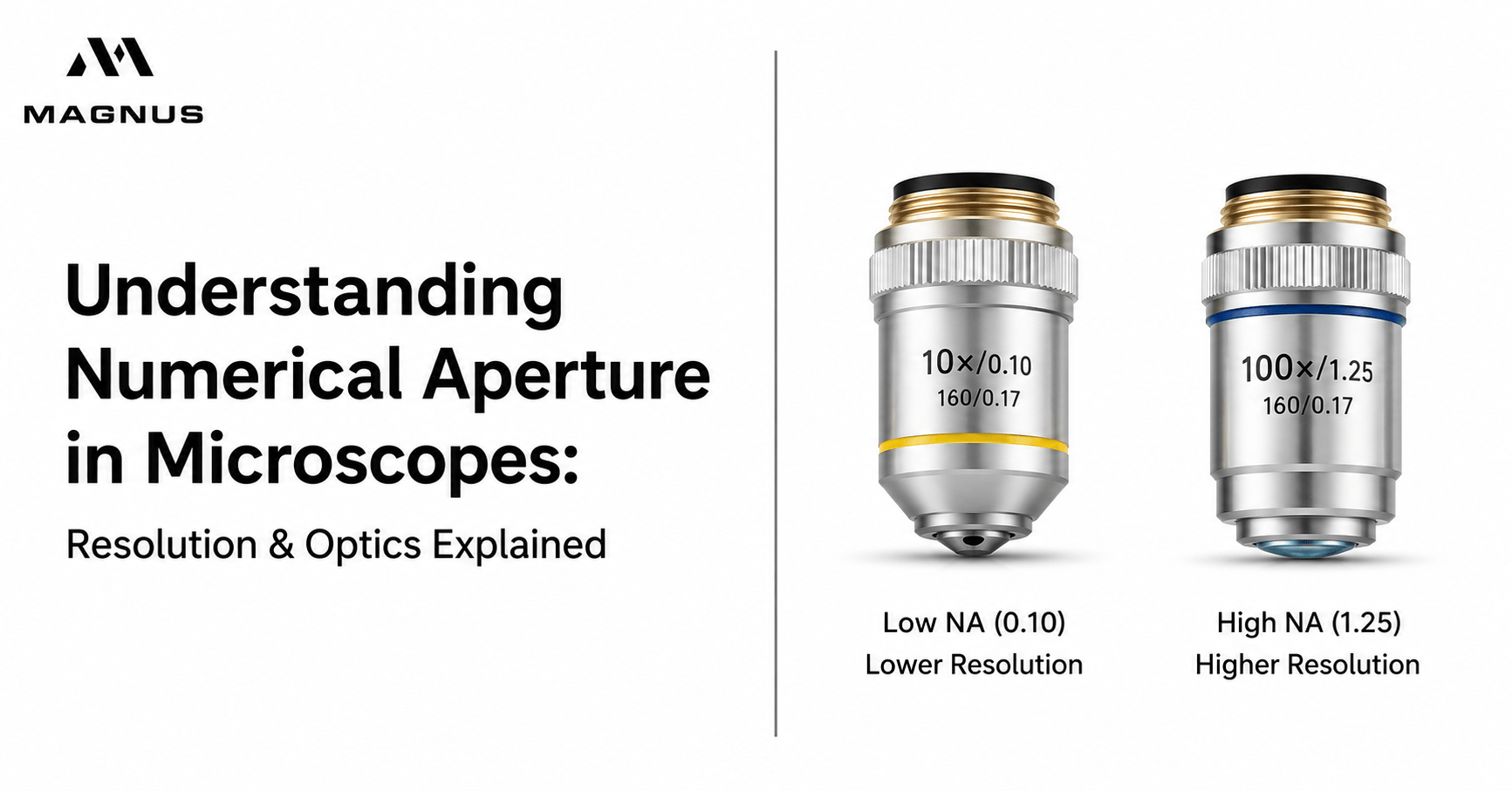
Numerical aperture is the concept used to describe the light-gathering efficiency of a microscope objective. This concept is represented by the letter NA. It is written on all microscope objectives. A high numerical aperture microscope value signifies good light gathering and sharp images. The numerical aperture depends on the objective angle and the refractive index of the medium between the objective and the specimen.
Why Numerical Aperture Is Important
- Numerical aperture affects image brightness and sharpness
- A low NA may create dark or blurry images
- A higher NA improves detail and contrast
- It helps users study tiny cells and tissues clearly
- Good optical performance supports better microscope viewing
- A strong numerical aperture microscope setup improves scientific observation and research work every day
- Numerical aperture helps improve microscope resolution for clearer images
- Better NA allows users to observe very small sample details more accurately
Connection Between NA and Microscope Resolution
The resolution of a microscope refers to the ability to discern two objects that are extremely close together. High resolution leads to enhanced clarity of images and their analysis. The resolution of the microscope is strongly influenced by the numerical aperture.
The microscope will be able to resolve even more microscopic features with greater clarity at higher numerical aperture values. High microscope resolution is essential for scientists and researchers in conducting research and experiments.
Objective Lens
The objective lens helps the microscope to make objects visible easily. It collects light from the sample and creates the first image clearly. The eyepiece magnifies the image and increases the zoom. The NA number written on the lens shows its optical strength.
A higher objective lens NA usually yields brighter, sharper images. Different objective lenses are made for different tasks. The objective lenses are also used for basic viewing, and others for detailed research. Choosing the correct objective lens helps to improve focus, contrast, and image quality in microscope observation and laboratory analysis.
How Light Collection Helps Image Quality
- More light creates brighter microscope images
- Better lighting improves image clarity
- Numerical aperture controls light collection
- Thin samples become easier to study
- Good lighting improves microscope resolution
- Better contrast helps users see tiny structures clearly
- Strong optical systems support scientific testing and laboratory research
Magnification and Resolution are Different
An increase in magnification causes enlargement of the object. Resolution determines the level of clarity with which the details of the object can be observed. Microscopes enable magnification of the image many times, and the object may not appear clear because of the poor resolution.
High magnification will only make the blur bigger without sufficient NA. This is why microscope users must focus on both image size and resolution. Understanding this difference helps users get better results during scientific studies and microscope observations.
Why Immersion Media Is Used
Some microscope objectives use oil or water between the objective lens and the specimen. This is referred to as the immersion medium. The advantage of using immersion techniques is that they increase the amount of light entering the lens. This technique is normally applied to lenses having high NA values. Oil immersion objectives are quite popular in biology and medical laboratories because they enable clear visualization of bacteria and cells. Using immersion media correctly can improve the objective lens's NA performance and produce brighter, sharper images for advanced microscopy and professional laboratory work.
Factors That Affect Numerical Aperture
Many things can affect the numerical aperture of a microscope lens. The refractive index between the sample and the lens is very important. The angle of light entering the lens also changes the NA performance.
Lens quality and glass design can improve image brightness and sharpness. Dust, dirt, and poor microscope alignment may reduce image quality. Learning about these factors helps users improve the performance of numerical aperture microscopes and maintain better results during daily laboratory and classroom use.
| Factor | Effect on Microscope |
|---|---|
| Lens quality | Improves image clarity |
| Light angle | Changes NA performance |
| Dust on the lens | Reduces image sharpness |
| Immersion oil | Improves light collection |
| Poor alignment | Causes blurry images |
Choosing the Right Microscope Lens
- School microscopes may use lower NA lenses
- Research labs often need higher NA values
- Medical imaging requires better detail visibility
- Users should compare NA values carefully
- A higher objective lens NA supports advanced imaging
- The correct lens improves image accuracy and viewing comfort
- Good lens selection supports better laboratory and research results
Cleaning and Maintaining Microscope Lenses
The microscope lens is important for good image quality and clarity, and it should be kept clean and safe. The presence of dust, smudges, and other contaminants can reduce the image's brightness and blur it.
Careful cleaning with lens paper can improve image quality. The harsh cleaning materials can scratch the lens surface. Maintenance increases the numerical aperture and improves the microscope's resolution. Proper care of the lens increases its durability and maintains its operational performance.
Wrapping Up
Numerical aperture is a very important part of microscope performance to show image quality. It controls light collection, image brightness, sharpness, and detail quality. Understanding NA helps users choose better lenses and improve image results for science, education, and medical work.
A good optical system supports clearer viewing and more accurate research observations. Magnus Opto offers advanced microscope solutions for schools, laboratories, and research centers to help them view small particles easily. The modern microscopes are designed for clear imaging and long-term performance. Contact Magnus Opto today to explore microscope systems that support accurate research, better learning, and professional laboratory work.
FAQs
1. What is numerical aperture in a microscope?
Numerical aperture, or NA, is a measure of how much light a microscope objective lens can collect from the specimen. A higher numerical aperture microscope objective gathers more light, which helps produce brighter, sharper, and more detailed images during observation.
2. Why is numerical aperture important in microscope resolution?
Numerical aperture directly affects microscope resolution because it controls the lens's ability to collect light and separate fine details. A higher NA allows the microscope to distinguish two closely placed points more clearly, improving image sharpness and accuracy.
3. What is the difference between magnification and resolution in microscopes?
Magnification enlarges the size of the image, while resolution determines how clearly fine details can be seen. A microscope may offer high magnification, but without good numerical aperture and resolution, the enlarged image can still appear blurry.
4. How does the objective lens NA affect image quality?
The objective lens NA affects image brightness, clarity, contrast, and detail visibility. A higher objective lens NA usually provides sharper images and better light collection, making it useful for viewing tiny cells, tissues, bacteria, and other microscopic structures.
5. Why is immersion oil used with high NA microscope objectives?
Immersion oil is used to improve light transmission between the specimen and the objective lens. It increases the refractive index, allowing more light to enter the lens. This helps high NA objectives produce brighter, sharper, and higher-resolution microscope images.
6. How do I choose the right microscope objective lens?
Choose a microscope objective lens based on the level of detail required. School and routine lab use may need lower NA lenses, while research, medical imaging, and advanced microscopy often require higher NA objectives for better resolution, contrast, and image accuracy.