


CH20i, MX21i or MLXi Plus: Which Magnus Microscope Is Right for Your Laboratory?
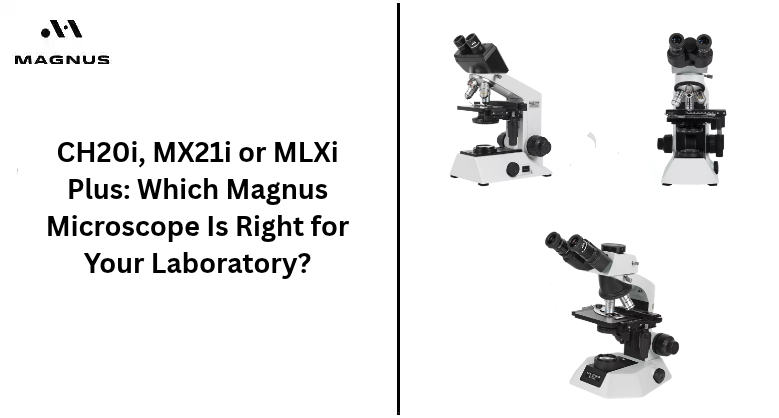
The right choice of the Magnus microscope will depend on the applications, the nature of observation and the type of accessories you have in your laboratory. The CH20i, the MX21i and the MLXi Plus have specific characteristics that suit different purposes like learning, medical and research, respectively. All of them incorporate Japanese optical technology and ergonomic observation.
Nevertheless, it is possible that certain aspects like the optical system, observation head, mechanical stage and accessories will influence your choice. Knowing these variations makes it easier for laboratories to get the appropriate equipment without having to purchase something which they might not necessarily require.
This guide compares the three models to simplify your selection.
Understanding the CH20i Microscope
CH20i is one of the most widely used microscopes due to its wide use in biology and education. An achromatic lens system, antifungal eyepieces, and an ergonomic design are some features that make it possible to observe specimens regularly. CH20i microscope provides magnifications from 40x to 1000x.
Key Features of CH20i
- Objectives: iNEA achromat objectives at 4X, 10X, 40X, and 100X.
- Eyepieces: Paired 10X eyepieces with an 18mm field number.
- Illumination: Available with halogen, LED, or LED illumination with battery backup.
- Stage: Coaxial mechanical stage with dimensions of 120 x 132mm.
- Accessories: Compatible with phase contrast, dark field, polarising, drawing, and digital camera.
These qualities enable it to serve as a useful Magnus microscope for teaching purposes especially where biological slides are analysed.
Exploring the MX21i Microscope
The MX21i is designed for clinical applications requiring enhanced optical performance. Its infinity-corrected plan optical system and wider field of view support detailed observation. The MX21i microscope also accommodates optical fluorescence and phase contrast attachments, expanding its capabilities for specialised laboratory work.
Key Features of MX21i
- Objectives: Design infinity achromat objectives of 4X, 10X, 40X, and 100X magnifications.
- Eyepieces: 10X eyepieces in pairs with a 20 mm field number and eye guards.
- Observation tube: Binocular/trinocular with 30 degrees inclination.
- Illumination: Options include halogen illumination, LED or rechargeable LED illumination.
- Accessories: It can be used with accessories like fluorescence, phase contrast, dark field, polarising, and Kohler accessories.
This makes it an effective choice for use in a clinical laboratory.
About the MLXi Plus Microscope
The MLXi Plus combines optical excellence with modularity for clinical and research purposes. The MLXi Plus microscope provides flexible observation systems that include monocular, binocular, and trinocular heads. It also provides a variety of observation heights and accessories.
Key Features of MLXi Plus
- Objectives: Design infinitely corrected achromatic objectives at 4X, 10X, 40X, and 100X.
- Observation heads: Monocular, binocular, and trinocular designs available.
- Stage: Mechanical stage size 125 x 145mm and has two-slide holder design.
- Focusing: Coaxial coarse and fine adjustment system with 0.2mm fine focus adjustment.
- Accessories: Fluorescence, phase contrast, dark field, polarizing, and Kohler illumination systems.
The flexible design is ideal for those who want to have a Magnus compound microscope where accessories can be added.
CH20i vs MX21i vs MLXi Plus: A Comparison
The following model comparison highlights the differences that matter most during selection.
| Feature | CH20i | MX21i | MLXi Plus |
|---|---|---|---|
| Primary application | Biological and educational | Clinical | Clinical and research |
| Optical system | Achromat optics | Infinity-corrected plan optics | Infinity-corrected plan optics |
| Eyepiece field number | 18 mm | 20 mm | 20 mm |
| Observation heads | Binocular, trinocular | Binocular, trinocular | Monocular, binocular, trinocular |
| Mechanical stage | 120 x 132 mm | 120 x 132 mm, rackless | 125 x 145 mm |
| Slide holder | Single | Single | Dual |
| Magnification | 40x - 1000x | 40x - 1000x | 40x - 1000x |
| Illumination options | Halogen, LED, LED with battery backup | Halogen, LED, LED with battery backup | Halogen, LED, LED with battery backup |
| Notable compatibility | Phase contrast and other optional attachments | Fluorescence and phase contrast attachments | Fluorescence and phase contrast attachments |
How to Choose the Right Microscope for Your Laboratory
One may begin by explaining the specimens and the method of analysis in the lab. Educational institutions will look for simplicity, strength, and economy, while the clinical setting will need better optics and attachments. Besides magnification, one needs to consider illumination quality, since properly illuminated specimens are easier to observe.
Laboratories that analyze many slides will also have to take into account stage and focus control, as well as ease of observation. The CH20i suits routine biological work. The MX21i provides plan optics and compatibility with fluorescence attachments.
The MLXi Plus offers multiple observation head configurations and a larger stage with dual slide holders. These differences aid in determining a proper Magnus microscope for pathology lab needs, without necessarily presupposing that all laboratories require the most versatile model.
Which Model Offers the Best Value for Your Needs?
Your choice depends on how often you use each function. The CH20i, the best microscope for education, provides an option that is suitable for biological studies, whereas the MX21i would be ideal for clinical purposes using plan optics. The MLXi Plus model deserves consideration due to observation versatility, dual slide capability, and accessories.
Your selection of the right clinical microscope India would need to meet the needs of your lab's operations. Consider the whole set of components of the system, such as the observation head and the illumination system among others.
Bottom Line
Choosing the appropriate Magnus microscope requires a good combination of optical quality, ergonomic viewing, and accessories based on your laboratory needs. The CH20i microscope would be perfect for biological and educational purposes, the MX21i for clinical uses, and the MLXi Plus allows for more configuration possibilities for clinical and research purposes.
Magnus is a microscope manufacturing and exporting company with customers worldwide, precise optics, and an emphasis on quality. The microscopes of Magnus integrate Japanese optical technology with convenient functions suitable for different laboratories.
Contact Magnus regarding your laboratory needs and configurations.
FAQs
Q1. What is the difference between CH20i and MX21i?
CH20i uses achromat optics for biological and educational applications, while MX21i offers infinity-corrected plan optics for clinical applications.
Q2. Which Magnus microscope is suitable for education?
CH20i is an appropriate choice for educational labs, with achromat objectives, a magnification range of 40x to 1000x, and mechanical stage controls.
Q3. Which microscope is suitable for a pathology laboratory?
MX21i is ideal for clinical use, while MLXi Plus provides extra options in terms of observation and accessories.
Q4. What applications does MLXi Plus support?
MLXi Plus supports clinical and research applications, with optional fluorescence, phase contrast, dark field, and polarising attachments.
Q5. How should a laboratory compare microscope models?
Compare optical systems, magnification, illumination, observation heads, stage dimensions, compatible accessories, and the procedures performed regularly.
Reference