

How to Choose a Laboratory Microscope for Research, Education and Clinical Testing
A good microscope is a must in the laboratory for clear visualization and examination of samples and for the smooth running of the lab. Laboratories differ in functional needs, sample types and analyses.
For example, a research laboratory may demand a high degree of imaging capacity, while an educational laboratory requires user-friendly technology for teaching. However, clinical laboratories need good pictures and repeatable outcomes in the analysis of specimens.
Therefore, it is vital to know the features of a laboratory microscope as a basis for choosing the proper equipment for different specimen analyses. This blog explores how to choose a laboratory microscope for research, education and clinical testing.
What is the Purpose and Uses of a Laboratory Microscope?
The clinical laboratory microscope is an optical tool that helps to see the details of objects that cannot be observed with the naked eye. It is possible to observe cells, microorganisms, tissues and other items. The laboratory microscope can be used in scientific research, medical diagnostics, the pharmaceutical industry and in educational laboratories.
The laboratory microscope uses are,
- Studying cells, tissues and microorganisms in biological samples.
- Observation of slides in laboratory classes.
- Analyzing clinical specimens including blood smears and urine sediments.
- Study of structure and defects of material at a microscopic level.
- Recording of scientific results for further analysis.
The choice of microscope will depend on the required magnification and task. It is important to know the objective in order to choose the right equipment.
Explore Different Laboratory Microscope Types
There are also many laboratory microscope types used in labs with different applications.
- Compound microscopes - They are used to observe cells, microorganisms and prepared slides.
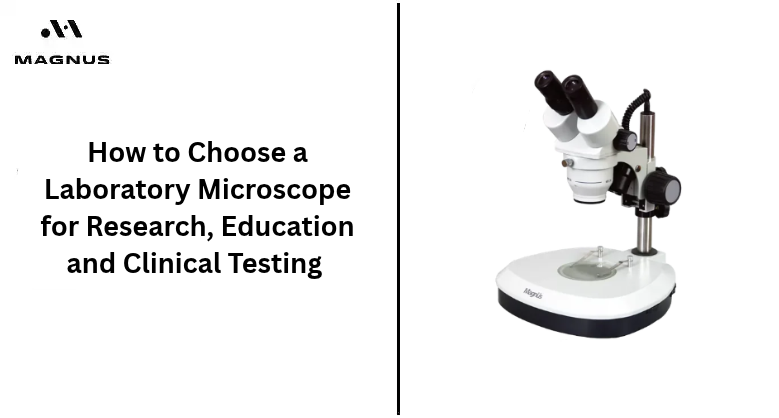
- Plain stereoscopes - They are used for the examination of insects and other three dimensional objects.
- Phase-contrast microscopes - They are helpful for viewing living and unstained cells.
- Fluorescence microscopes - They are helpful for the observation of living objects under fluorescent staining.
- Digital microscopes - Best for image and video recording.
- Inverted microscopes - Used to observe cultures and cells in vessels.
Finding appropriate laboratory microscopes for the type of samples, magnification, observation method etc. in labs.
Consider the Sample Type
The sample under investigation is an essential criterion for choosing a microscope because various samples will require different light paths and different working distances.
Prepared histological slides and blood smears should normally be observed with a compound microscope. Living cells can be viewed using phase contrast microscopy, and fluorochrome labelled specimens will require a proper fluorescence system.
In case of larger or solid specimens, stereo research laboratory microscope observation can be more convenient.
When buying a microscope for laboratory, take into account the following aspects:
- Transparent or opaque
- Stained or unstained
- Living, preserved, or prepared on slides
- Observation of surface structures or internal structures.
It is very important to match the specimen with the instrument for obtaining proper results without additional equipment.
Choose the Appropriate Magnification Range
The amount of enlargement achieved by an image depends on the magnification used with a microscope. Magnification range should be considered when choosing a microscope to be used in laboratory practice.
The objective lenses for the compound microscope will be 4x, 10x, 40x and 100x respectively. With the aid of a 10x eyepiece the resulting magnifications would be 40x, 100x, 400x and 1000x respectively.
Low power magnifications are employed in the process of specimen location, whereas high power magnifications are employed to discern finer details. An oil immersion lens with a 100× magnification is suitable for viewing stained bacteria.
Review Digital Documentation and Laboratory Workflow
Digital documentation capability affords the labs the ability to record, analyse, and share results. A digital camera or digital imaging device will record the normal image or video for study and clinical reporting. Consider the camera resolution, software compatibility, capacity to export photographs, and ability to take measurements before purchase.
Think about how the microscope will fit into the processes used in the laboratory workflow. It should be within reach for viewing and production of slides, as well as controls, and should be computer-compatible.
Compare Laboratory Microscope Price and Maintenance Costs
The laboratory microscope price varies depending on the optical system, the magnification capacity, image acquisition properties, construction quality, and special properties. Basic educational microscopes have fewer features compared to advanced research microscopes, but fluorescent and digital imaging systems can prove to be more costly.
It is recommended to compare the total cost of acquisition rather than the price alone. The following costs should be considered:
- Installation and training of staff where necessary.
- Cleaning and maintenance procedures.
- Cost of replacement for lamps, cameras, objectives, etc.
- Software licenses and upgrades when needed.
- Coverage of warranty and technical assistance.
What Features Should You Look for in a Laboratory Microscope?
The choice of the most suitable microscope will be defined by the analysis of the main components that are going to ensure a correct examination, efficient testing and operation. You should choose the best microscope for the laboratory to get a better view. The main elements that should be considered when choosing the equipment for laboratory use are the following.
- Sample Type: Select the sample type microscope that will allow you to study cells or other large objects.
- Objective Lenses: Choose objective lenses that are of good quality, as well as suitable for your lab work.
- Optical Resolution: The function of optical resolution is to determine whether the microscope can distinguish between two adjacent objects.
- Digital Documentation: Consider the possibility of installing the camera and taking pictures.
- Lighting system: The illumination system helps control light intensity and ensure consistent illumination across samples.
Wrapping It Up: A Summary
Selecting a proper laboratory microscope will ensure that all observations, testing, and research are done accurately. Magnus provides solutions in laboratory microscopy, intended to meet the needs of research, educational, and clinical tests.
If you need equipment for your everyday work and more sophisticated applications, consider the range of products by Magnus. Get in touch with Magnus now to learn more about the microscope solutions offered by the company.
FAQs
Q1. Which microscope will suit a laboratory?
The best microscope will depend on the type of samples and applications in the laboratory.
Q2. What are the various kinds of laboratory microscopes?
Some common types of laboratory microscopes are compound microscopes, stereo microscopes, phase contrast microscopes, fluorescent microscopes, digital microscopes and inverted microscopes.
Q3. What are the criteria that I should consider when selecting a microscope for clinical diagnosis?
A microscope which is selected for diagnosis must have suitable magnification, optical quality, good illumination, comfortable handling of the microscope and handling of clinical specimens.
Q4. What magnifications do you need in a research laboratory?
Commonly used magnifications in research laboratories range from 40x up to 1000x depending on the specimen and microscopy techniques.
Q5. What factors influence the cost of a laboratory microscope?
A laboratory microscope's price is influenced by the optics and their unique functions.
Source Link:
https://www.hemcmedical.com/microscopes-types-uses-benefits-complete-buying-guide/
https://www.dssimage.com/blog/research-microscope-buying-guide/
https://almicromicroscope.com/blog/how-to-choose-the-right-medical-research-microscope-for-your-lab